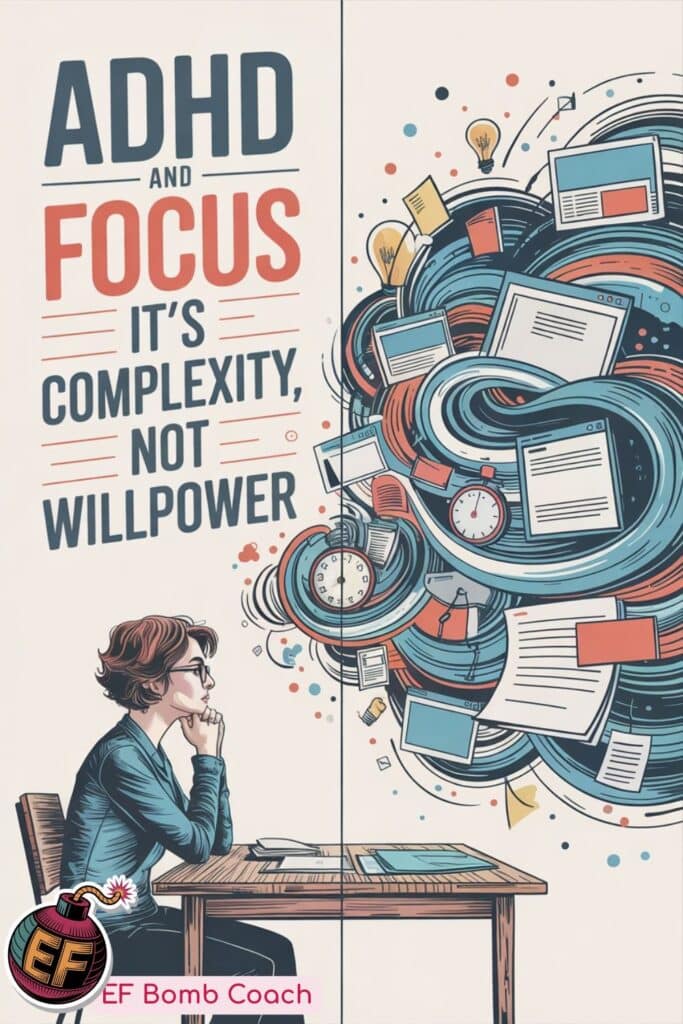
ADHD and Focus: It’s Complexity, Not Willpower
If you keep telling yourself you should be able to “just focus,” you're not alone. That advice sounds simple, but it breaks down fast when you have ADHD. Real change starts when you understand what's actually happening in your brain, not when you shame yourself into trying harder.
You're not failing a basic life skill. You're dealing with a system that works differently, in a world that often expects one “right” way to pay attention.
Why focus feels so hard for ADHD brains
You've probably heard the laziness story before, maybe from other people, maybe from your own inner voice. If focus is hard, the story goes, you must not care enough. Or you're not trying hard enough. Or you need “more discipline.”
But ADHD doesn't work like that. Focus is not a moral trait. It's a set of brain skills, and those skills can be unreliable from day to day.

Here are a few common focus myths, and what tends to be true instead:
- Myth: “If you really cared, you'd focus.”
Reality: Caring doesn't automatically create sustained attention, especially when a task isn't urgent or interesting. - Myth: “You just need fewer distractions.”
Reality: Distractions can be external and internal, and your brain may not filter either one consistently. - Myth: “Everyone struggles, so push through it.”
Reality: ADHD focus often comes with an effort cost that other people don't feel the same way. - Myth: “If you can focus sometimes, you should focus anytime.”
Reality: When you lock in for hours, it usually means the conditions were right, not that you suddenly became a different person.
When focus feels impossible, it helps to stop making it personal. Instead, you can treat it like data. What part is breaking down today, and what does your brain need right now?
The three skills that make up focus (it's not an on-off switch)
When someone tells you to “just focus,” they're usually talking like focus is one simple action. In real life, focus is three separate skills working together, and any one of them can be the weak link on a given day.
Think of it this way:
- Directing attention: You get your attention onto something, in other words, you begin.
- Sustained attention: You keep your attention there long enough to make progress.
- Disengaging attention: You pull your attention away when you're done, so you can stop or switch tasks.
For an ADHD brain, any of these three can glitch. What makes it extra frustrating is that it might not always break in the same place. One day you can start easily but can't stay. Another day you can't begin at all. Then, on a different day, you can't stop, even when you need food, sleep, or a bathroom break.
That inconsistency can make you doubt yourself. Still, it doesn't mean you're doing it wrong. It means your focus system isn't a single switch, and it isn't steady every day.
If you want a deeper look at how ADHD affects attention over time, you can also read this research summary on sustained attention in adult ADHD.
Spotting your focus breakdown today
Before you change your plan, get clear on what's actually hard right now: starting, staying, or stopping.
A few quick signs can help you name it:
- If you can open the doc but can't write a sentence, you're likely struggling with directing attention.
- If you start strong and then reread the same paragraph four times, you're likely fighting sustained attention.
- If you can't pull away from the task, even when you need to switch, you're dealing with disengaging attention.
Once you name the problem, you stop throwing random solutions at it. You can match the support to the skill that needs help.

What sustained attention looks like (and why it's exhausting)
Sustained attention is the one that tends to trip ADHD brains the most. Starting can be hard, sure, but maintaining focus can feel like carrying something heavy for longer than your muscles want to cooperate.
Sustained attention shows up in everyday moments that look “easy” from the outside. Here are a few examples that make it real:
| Struggle area | What it can look like day to day |
|---|---|
| Reading | You get through two paragraphs, then reread them four times. |
| Meetings | You're physically present, but your mind has left the building. |
| Tasks | You try to work, but 17 browser tabs multiply like rabbits. |
| Conversations | You follow along, then lose the thread halfway through. |
This is the part people often miss: sustained attention can be genuinely exhausting for ADHD brains in a way it often isn't for neurotypical ones. It can take more effort to do the same task for the same amount of time.
One reason is that the ADHD brain often runs a hair-trigger alert system. Your attention keeps scanning the environment and asking:
Is this new? Urgent? Dangerous? Interesting?
If the answer is no, your brain goes hunting for something that is. That's not a character flaw. It's a protective pattern that made sense for survival.
In a cave, the person who notices the rustling bush survives. The person who stays calmly focused on flatbread and ignores the rustling might not.
In modern life, though, you're not listening for predators. You're trying to do quarterly taxes. You're trying to sit through long Zoom calls. You're trying to complete the boring step that makes the rest of the project work. That same scanning system that once protected you can now pull you off task again and again.

The mismatch: your ADHD brain in a modern world
Modern work comes with constant competition for your attention. Some of it is obvious, like a loud conversation in the hallway, a truck going by, or your pet sprinting under your feet.
Then there's the internal noise. Thoughts, reminders, worries, ideas, and sudden curiosity can all shout at once.
Neurotypical brains often have a stronger filter. They can notice the noise, then push it to the background. With ADHD, that filter can be patchy. Sometimes it works. Sometimes it doesn't. So when someone says “just tune it out,” they're describing a skill your brain may not execute reliably, even when you want to.
That's why environment matters so much, although the bigger point is simpler: the noise is real, it's tiring, and it isn't your fault.
If it helps to see attention broken down in different categories, this overview of types of attention affected by ADHD can give you language for what you're experiencing.

The effort gap: why ADHD focus costs more
Even when you and a neurotypical person finish the same task, you might pay a much higher energy price to get there. That's the effort gap. It's why you can “do everything right” and still end the day wiped out.
A helpful image is the driving comparison:
A neurotypical brain focusing is like driving on a smooth highway.
An ADHD brain focusing is like driving that same highway with a flat tire, in a storm, with someone in the backseat asking questions nonstop.
You both arrive at the same place. Still, you arrive with very different levels of fatigue.
That's why you can hit 2:00 PM and feel empty, while someone else can attend a 3:00 PM meeting and stay engaged. It's not that you're lazy. It's that your fuel tank drains faster because focus costs you more.
This is also why you sometimes confuse yourself. You think, “But I focused for four hours on that one thing.” Yes, you did. That task probably had the ingredients your brain needs, like urgency, novelty, interest, a clear next step, or built-in feedback.
So the goal isn't to force equal focus on everything. The goal is to understand what helps your brain engage, then build more of those conditions into your work. If you want a related explanation of why attention can feel impossible even on tasks you care about, this post on why sustained focus feels impossible connects the dots in plain language.
Stop yelling at yourself to focus
Think about the last time you tried to muscle your way through a focus block. Maybe you told yourself, “Try harder,” or “Why can't you just do it?” The intent makes sense. You want to show up. You want to do what you said you'd do.
The problem is the approach can work against your brain.
When you force it, anxiety often spikes. Your brain reads that stress as a threat. Then your system floods with stress hormones, and the part of your brain that helps with planning and focus can go partially offline. In other words, you flip your lid, and now you have less access to the focus you were trying to create.
For ADHD, stress is not a reliable motivator for sustained attention. It's usually the enemy.
That's also why shame spirals hit so hard. When you beat yourself up with “I'm lazy” or “Everyone else can,” you're not just feeling bad. You're also making the focus problem worse in real time.

Did you know I have a membership for women who want to improve their executive function skills? Check it out here.
Normalize your ADHD focus patterns instead of chasing “perfect”
If your focus changes a lot from day to day, it's easy to assume you're doing something wrong. You might even think you've “fallen off the wagon” because today doesn't look like yesterday.
But variable focus is normal for ADHD. Some days are simply harder. That doesn't mean you're broken, and it doesn't mean you're back at square one. Sometimes it's just a regular Tuesday.
The bigger trap is trying to measure yourself against a neurotypical standard of steady, consistent focus every day. That's not a fair scoreboard for your brain. You end up chasing a version of productivity that punishes you for how you're wired.
A more realistic target is:
- Understand your patterns.
- Work with your rhythms.
- Stop treating empty-tank days like a personal failure.
This shift matters even more if you run a business. You're not only managing tasks, you're also managing decisions, relationships, deadlines, and income. When you normalize your attention roller coaster, you can build systems that support you instead of systems that shame you.
Practical shifts that make focus easier (without forcing it)
Once you accept that focus is complex, you can make small adjustments that fit how your brain actually works. None of these are magic. They're just more useful than “try harder.”
Here are a few practical shifts to test:
- Notice which part of focus is struggling, starting, staying, or stopping.
- Reduce internal noise before you expect long stretches of attention.
- Pay attention to your high-energy windows, then match your hardest tasks to those times.
- Give yourself permission to work in shorter bursts, even if your interval is 10 or 15 minutes.
- Stop grading yourself against neurotypical standards, because that comparison rarely helps.
The Pomodoro method can be great, but the standard 25-minute timer isn't sacred. If 25 minutes makes you restless, anxious, or rebellious, shorten it. If 10 minutes gets you moving, that counts. Consistency often comes from choosing a size your brain will actually do.
If you also swing between procrastination and hyperfocus, it can help to name that pattern too. This article on the ADHD cycle of procrastination and hyperfocus gives language for that push-pull, which can make planning your day feel less confusing.
Focus feels hard because it is hard for your brain.
You can't change the whole world, but you can change your approach.
You don't need more willpower, you need a better map of how focus works for you. Once you treat focus as three skills, not a single switch, you can stop blaming yourself and start adjusting your conditions. Pay attention to your effort gap, protect yourself from stress spirals, and build your day around energy instead of guilt. When you work with your brain, focus stops being a character test and becomes something you can plan for.