The Real Reason Distraction Hits (Especially With ADHD)
You've heard the standard focus advice a hundred times: put your phone in another room, turn off notifications, use an app blocker, find a quiet space. Those tips can help, but if they were enough, you wouldn't still feel like your attention gets yanked away every few minutes.
The problem is that, for an ADHD brain, distraction usually isn't mainly an external problem. It's an internal problem. Until you address what's happening inside your head, no amount of blockers or willpower pep talks will feel consistent.
Why Your ADHD Brain Gets Distracted (It's Not What You Think)

Distraction gets treated like a character flaw, like you're “undisciplined” or “lazy.”
That story sounds convincing when you keep checking your phone or bouncing between tabs, but it's not accurate.
Your brain's job is to scan the environment for anything new or important.
That's the basic design. An ADHD brain often has the sensitivity turned up and the filter turned down. So you notice more, faster. The same trait that makes it hard to ignore a notification also makes you creative, perceptive, and often great in a crisis. You're not easily distracted because you're weak. You're easily distracted because your brain is exceptionally good at noticing things.
The goal, then, isn't to stop noticing. The goal is to give your brain what it needs so it stops going hunting for “new and interesting” every time the current task gets boring, unclear, or stressful.
If you want a broader set of ADHD-friendly productivity ideas to pair with what you'll learn here, you might also like 6 productivity tips that actually work for ADHD brains. Still, the biggest shift starts with understanding what kind of distraction you're dealing with in the moment.
Attention Deficit? Nope, It's Attention to Everything
“Attention deficit” makes it sound like you can't pay attention. A more useful way to think about it is this: you're paying attention to all the things, and then you get to deal with the chaos that creates.
Most productivity advice focuses on external distractions, like:
- Notifications and pings
- Noise and movement
- Other people in your space
- Visual clutter that keeps pulling your eyes away
Those are real, and you can reduce them. But ADHD distraction often keeps happening even when you “do everything right” on the outside.
Spotting Internal vs. External Distractions
External distractions are easier to see. Something happens around you, and your attention shifts. Your phone lights up, someone walks by, a tab flashes, a sound grabs you. You look away, then you're gone.
Internal distractions are sneakier. Your body is sitting there. You look like you're working. Meanwhile, your brain has left the building twelve times in five minutes.
Here's the key line to remember: no app blocks your own thoughts.
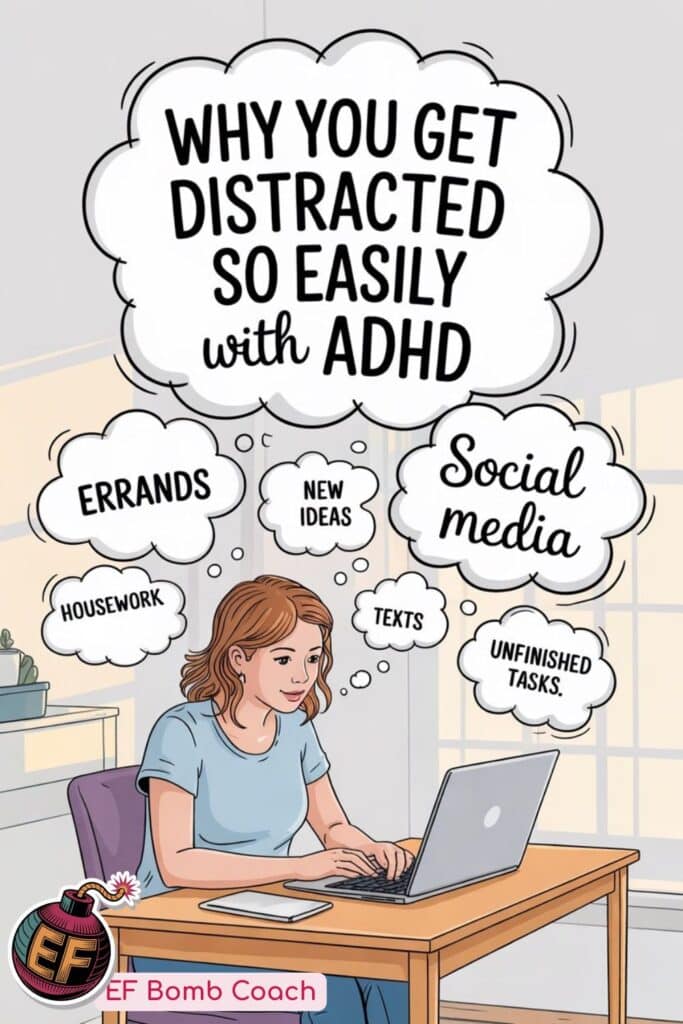
If you've ever sat in a quiet room with no phone nearby and still couldn't focus, that's internal distraction. It can sound like worries, mental chatter, random ideas, or your brain trying to solve five other problems while you're staring at one document.
When you can tell which type is derailing you, you can pick the right tool instead of just trying harder.
The “I'll Need to Remember That” Spiral
One classic ADHD loop looks harmless at first, but it can wreck your focus fast:
- An idea pops into your head.
- You're sure you'll forget it (because your working memory is unreliable).
- You keep repeating it mentally, so you don't lose it, and you stop doing the task in front of you.
It's like having too many browser tabs open and not enough RAM. Your brain keeps pushing the “urgent” stuff to the top because it doesn't trust itself to hold it later. The good news is the fix can be simple, once you stop trying to carry everything in your head.
The Hidden Fuels of Distraction: Perfectionism and Friction
Sometimes you're not distracted, you're avoiding. That matters, because avoidance needs a different solution than “remove distractions.”
Perfectionism is a big driver here. If some part of you believes that doing the task risks failure or judgment, distraction becomes a comfortable exit ramp. Scrolling or reorganizing your inbox can feel safer than facing the anxiety of, “What if I do this wrong?”
That's not laziness. It's self-protection. If you don't do the thing, you can't be criticized for how you did it. Your brain is choosing relief now over stress now.
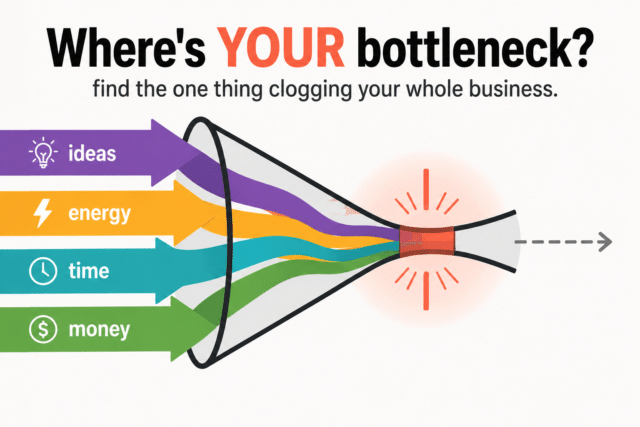
Friction is the other hidden driver. Friction is any small barrier between you and starting. ADHD brains are especially vulnerable to friction because task initiation is already costly. Add a few extra micro-steps, and your brain can “nope” out before you even begin.
Think about workout clothes. If they're buried in a drawer and you have to hunt for them, you're less likely to work out. If they're laid out, starting feels easier. Work tasks work the same way. Every decision you have to make before you begin is friction. Every unclear next step is friction.
If you keep asking “Why can't I start?”, check for fear and friction before you assume you're broken.
This is also why “just use more discipline” falls flat. You're not fighting a single bad habit. You're dealing with how your brain responds to stress, uncertainty, and extra steps.

Perfectionism: Your Brain's Exit Ramp
Perfectionism-driven distraction often has a specific feel. The task matters, the stakes feel high, and suddenly anything else looks appealing.
It can look like procrastination on the outside, but inside it's usually more like:
- You want it to be good, so starting feels risky.
- You imagine judgment, so your brain searches for escape.
- You pick a quick dopamine hit instead (hello, social media).
Once you name it, you can stop arguing with yourself. “I'm not distracted, I'm scared this won't be good enough” gives you something real to work with.
Friction: Sneaky Barriers to Starting
Friction doesn't announce itself. It disguises itself as “I don't feel like it” or “I'll do it later.” Meanwhile, what's actually happening is that you're facing a pile of tiny steps before you can do the real work.
For example, you sit down to write and realize you have to:
Find the file, decide what you're writing first, open five tools, remember what you planned, choose a headline, pick a format, and then figure out what to say.
That's a lot. And task initiation is already expensive. Reducing friction is not a cute bonus strategy. It's how you make starting possible on low executive-function days.
Proven Ways to Cut External Distractions (And Why They Work)
External fixes aren't useless. They just aren't the whole solution. They work best when you understand the “why” behind them, because then you're more likely to actually do them.
Here are the big ones:
- Put your phone out of sight. Your brain has habit loops tied to your phone. Even seeing it can trigger the urge to check. “Out of sight” often becomes “less in mind,” which lowers the pull.
- Turn off notifications. Notifications are built to hijack attention. Every ping is a tiny dopamine hit. Turn them off not because you “should have more willpower,” but because you're removing a trap that was engineered to be compelling.
- Create a consistent focus cue. Your brain links environments with behaviors. A dedicated focus space (even if it's just one chair) paired with the same music can become a focus cue over time.
- Reduce sensory load. Less noise means less sensory processing. When there are fewer things competing for attention, what's in front of you has a better chance of staying in the spotlight.
If you want a more clinical-style list of focus supports to compare with these, you can also reference How to Focus with ADHD: 11 Proven Strategies. Use it as a menu, not a mandate.
Tame Internal Distractions with One 5-Minute Tool
If you do one thing from this whole approach, make it this: the brain dump.

Internal distraction often happens because your brain is trying to hold too many things at once, and it doesn't trust itself to remember them later. So it keeps resurfacing the same thought: “Don't forget this.” That's not you being dramatic. That's your brain trying to prevent loss.
A brain dump is permission to stop carrying it all.
You're telling your brain, “It's captured. It's safe. You can let go now.”
Here's what it looks like:
- Grab a piece of paper (or open a simple note).
- Dump everything out: worries, tasks, random ideas, reminders, “oh yeah” thoughts.
- Don't organize it yet. Just get it out of your head. Then go back to your task.
The magic isn't in making the list pretty. The magic is in writing it down so your brain stops looping. Once it trusts that you can return to the list later, you get mental space back.
Beat Avoidance and Friction Like This (Without Trying to “Hack” Yourself)
You can't productivity-hack your way out of fear. If the real issue is fear of failure, no timer will fix that by itself. You have to go one level deeper.
Start by naming what's true. Say it plainly. “I'm not distracted. I'm scared this won't be good enough.” That sentence turns a foggy problem into useful information.
Then shrink the task until your brain stops panicking.
“Write my sales page” can feel huge. “Write one sentence that describes what I do” is survivable. Starting imperfectly is more useful than waiting for perfect.
Also, reduce friction before you need focus. In the moment, your executive function is already doing heavy lifting. So prep ahead when you can. Here's a simple trick that works because it reduces decisions: write one sentence the night before, “Tomorrow I'm starting with X.” When you sit down, you're not figuring it out from scratch.
Environment design helps here too. Make the right thing the easy thing. Put what you need where you can see it. Use visual reminders, a sticky note, or a wall calendar. The goal is to remove decisions so you can start with less pushback.
Done imperfectly and started beats perfect and paralyzed.
Shrink It and Start
The smaller the first step, the less your brain needs to brace itself.
A few examples of “too big” vs. “small enough”:
- “Write my sales page” vs. “Write one headline”
- “Fix my marketing” vs. “Draft one offer sentence”
- “Do my bookkeeping” vs. “Open the spreadsheet”
You're not lowering standards. You're lowering the starting barrier.
Prep Your Environment Ahead
If you wait until you're already resisting, everything feels harder. Prep cuts that resistance early.
Try simple setups like:
- Open the file you'll need before you stop for the day.
- Leave yourself a single starting instruction for tomorrow.
- Put the one tool you need in plain sight.
Friction hides inside “little” steps. Remove a few, and starting can feel 50 percent easier.

Did you know I have a membership for women who want to improve their executive function skills? Check it out here.
Your Quick Plan When Distraction Hits (So You Don't Spiral)
You will drift mid-sprint. That's not a failure, it's expected. The goal isn't “never drift.” The goal is a fast, low-drama return.
Use this simple response plan:
- Notice without judgment. Getting mad at yourself wastes time and keeps you off task longer.
- Capture the distraction. If it's a thought or an idea, add it to your brain dump list. You can also keep a separate note called a “parking lot.”
- Return to the exact task. Not your whole to-do list. Not “finish the sales page.” Come back to “write this headline.”
- Reset the timer if needed. Resetting isn't cheating. A clean sprint starting now beats a half-abandoned sprint you're trying to salvage.
Over time, that gap between “I drifted” and “I'm back” gets smaller. You're building a skill, not chasing a perfect focus streak.
Pick One Tool and Try It Now
Don't take all of this and turn it into a new form of procrastination. Pick one strategy and test it today, because information without action is just really well organized procrastination.
Distraction isn't proof you're broken. Most of the time, it's a signal that your brain is overloaded, avoiding a fear, or getting stuck on friction. When you separate external distractions from internal ones, you can finally use the right tool instead of defaulting to shame. Start small, capture what your brain is trying to hold, and practice coming back without drama, because focus is a system, not a personality trait.