The Minimum Viable Day: A Better ADHD Productivity System
You can get real work done and still end the day feeling like you failed. That usually means your finish line was wrong, not that you were lazy.
If you have ADHD, your energy, focus, and executive function don't show up the same way every day. A minimum viable day gives you a floor you can still hit when your brain is scattered, your morning gets hijacked, or the whole plan falls apart.
Once your finish line starts moving with you, productivity stops feeling like punishment.
Why most productivity advice breaks on ADHD days
A lot of productivity advice assumes your brain will behave the same way on Tuesday that it did on Monday. It assumes the plan you made yesterday will still fit today. It assumes focus can be called up on command if you're disciplined enough.
If you have an ADHD brain, you already know that's shaky ground.
Some days you can lock in for hours and do what feels like three weeks of work. Other days you sit down, open the file, and your brain will not load. The task didn't change. You didn't suddenly become incapable. Your brain is variable, and any system that ignores that is going to fail you over and over.
Here is what most systems assume, compared with what your days may look like in real life:
| Traditional productivity assumption | What your real day may look like |
|---|---|
| Your energy stays fairly steady | Your energy can swing hard from one day to the next |
| Yesterday's plan should still work today | Today's brain may not cooperate with yesterday's optimism |
| Focus comes from discipline and habit | Executive function may show up late, weak, or not at all |
| A missed plan means you fell short | The plan may have been built for a different kind of day |
That variability is not proof that your brain is broken. It's part of neurodivergent wiring. The same brain that can hyperfocus for six hours on one day can make a basic admin task feel like moving through concrete on another.
The bigger problem is that most productivity systems are built for good days only. They fit the days when your focus is available, your energy is decent, and nothing unexpected blows a hole in your schedule. On every other kind of day, the system stops matching reality, and you end up blaming yourself.
That's why you can do things all day and still close the day feeling behind. You were measuring yourself against a finish line built for peak performance, not the brain and energy you had in front of you.
What a minimum viable day gives you
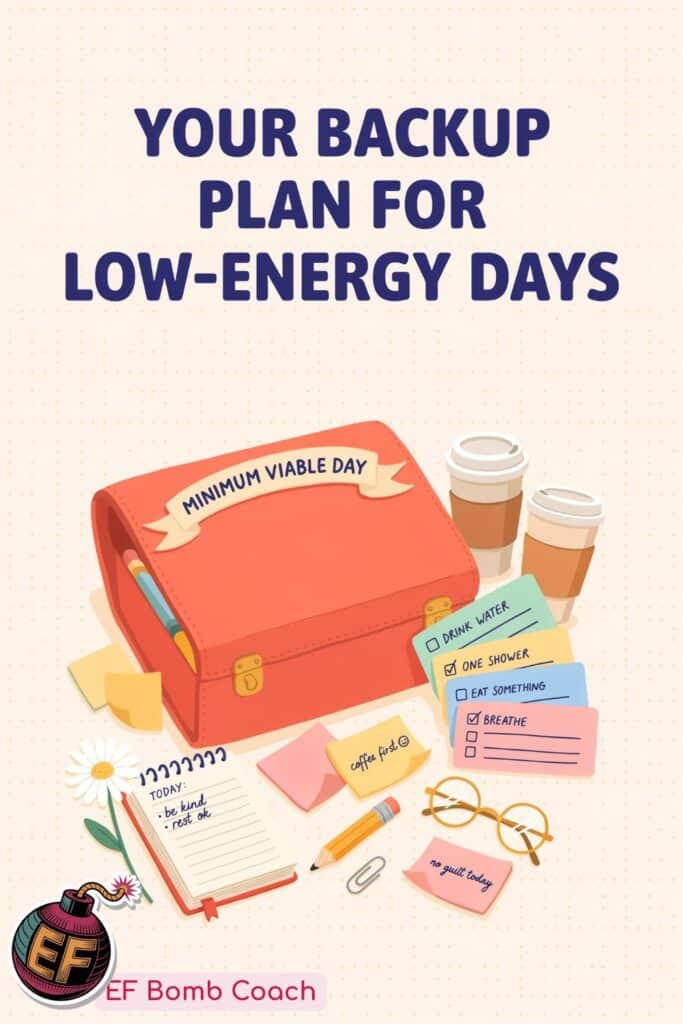
A minimum viable day is the smallest version of a productive day that you can look back on and honestly say, “Yeah, that counted.”
It's not your ideal day. It's not your full task list. It's not you lowering your standards forever. It's your floor, the baseline you're protecting no matter what else happens.
The minimum viable day is a finish line that moves with you instead of staying fixed while you fall behind.
That matters because hard days don't only drain your energy. They also drain your ability to decide. When your executive function is shaky, the last thing you need is to spend more mental energy figuring out what matters most. If that sounds familiar, this breakdown of ADHD decision fatigue puts words to why even small choices can start to feel absurdly heavy.
A pre-decided minimum viable day removes that extra layer of friction. You don't have to negotiate with yourself about where to start. You don't have to sort through a giant to-do list while your brain is already struggling. You already know what today requires.
It also helps with the all-or-nothing thinking that shows up so often with ADHD. When the original plan falls apart, it's easy to decide the whole day is shot and check out. A minimum viable day interrupts that spiral. If Plan A dies by 10:17 a.m., you don't have to write off the day. You shift to the floor plan.
That one change can be huge. Instead of ending the day with, “I failed again,” you can end it with, “I protected what mattered most.” That's a very different story to tell yourself.
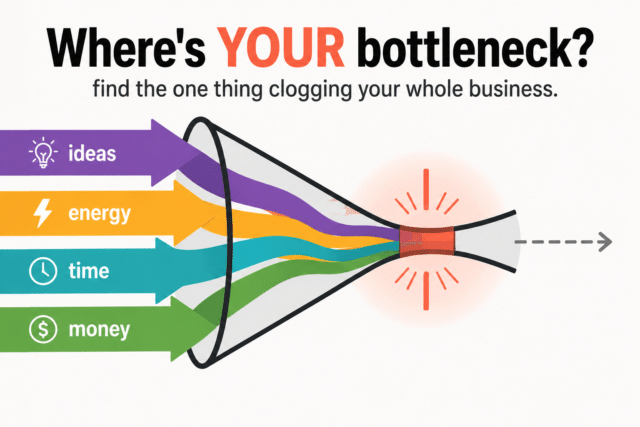
How to build your minimum viable day
The rule is simple: keep it to three items max.
Not five things you could maybe do on a medium-energy day. Not a sneaky mini master list. Three things you can complete when your brain is running at about 60%.
Each item needs a clear finish line. If you can't tell when it's done, it doesn't belong on your minimum viable day.
“Work on email” is too vague. “Reply to three flagged client emails” works.
“Do some marketing” is too vague. “Post one piece of content” works.
“Make progress on onboarding” is too vague. “Send the welcome packet to the new client” works.
That level of detail matters because fuzzy tasks create more decision-making, and decision-making is exactly what you're trying to reduce. Your minimum viable day should not ask your brain to keep interpreting what you meant.
At least one of your three items should protect something tied to revenue or client relationships. Those are the parts of your business that get expensive fast when they slide. At least one item should also be genuinely doable on a bad day. If all three tasks need your sharpest, cleanest thinking, your floor is too high.
Ask these three questions when you're not sure what makes the cut
- If you woke up tomorrow with a fever and could only do a couple of things before going back to bed, what would still need to happen?
- What would make you feel okay about today even if nothing else happened?
- If you skipped this task, would it create a real problem, like a missed deadline, lost revenue, or a client left waiting?
Those questions strip away a lot of noise.
“Okay” is the right target here, not “impressive.” You're not trying to design a day that earns a gold star. You're trying to define the floor.
That last question is the one people miss most. Discomfort is not the same as consequence. A task can nag at you and still not belong on your minimum viable day. If skipping it only makes you itchy, it may not make the cut. If skipping it creates a concrete problem, it probably does.
Make it a system, not a mood
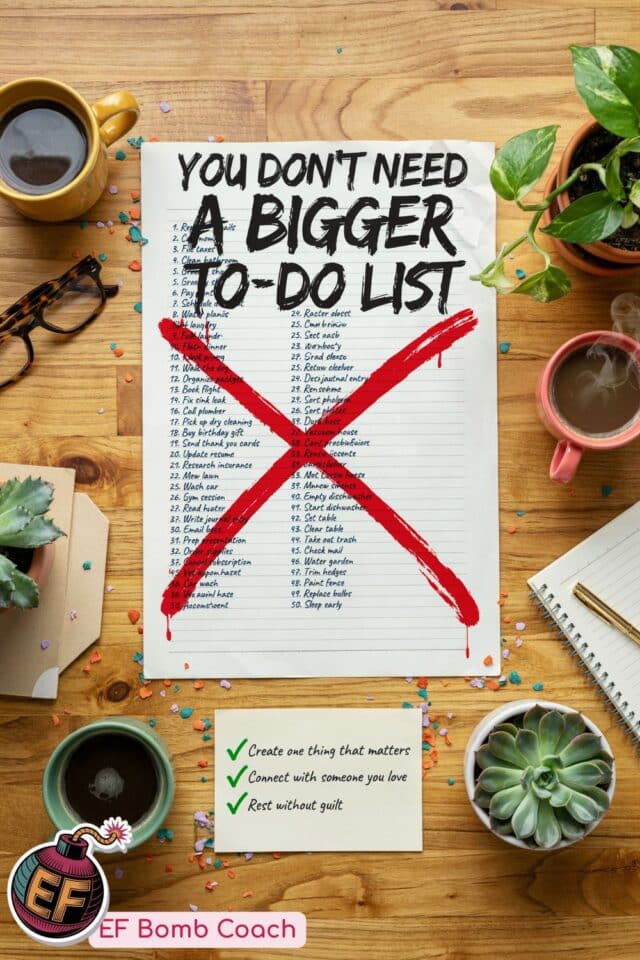
Your to-do list and your minimum viable day are not the same thing.
A to-do list is storage. It's where everything lives until it has a turn. Your minimum viable day is a commitment about what today requires.
That commitment works best when you make it before the day gets loud. Pick your three items the night before, or first thing in the morning before email, Slack, texts, and random requests start chewing through your attention.
Then write it down somewhere visible. A sticky note is fine. A whiteboard is fine. An index card on your desk is fine. A notes app is fine if that's what you'll look at. What doesn't work is keeping it in your head and hoping you'll remember it when the day gets messy.
Your head is not a reliable storage system on hard days.
You also don't need one fixed version for every day. You can keep a few versions ready.
A low-energy day version might focus on protecting client communication and doing one revenue-touching task. A high-chaos day version, where half your morning disappears before you even start, might be one communication task and one thing that helps you get grounded enough to keep going. On sick days or real crisis days, the minimum viable version may be one thing. Some days the most viable version of the day is rest, recovery, and not making things worse. That counts too.
This is not permission to coast all the time. On good days, you go for the ceiling. You run the bigger plan. You do more because you can. The minimum viable day is the safety net for the days when your brain, your energy, or your life won't cooperate.
And weirdly, that safety net often makes you more willing to try bigger things. When you know there's a floor that will catch you, you're less likely to freeze at the thought of missing the perfect plan.

Did you know I have a membership for women who want to improve their executive function skills? Check it out here.
Try this for five days before you judge it
Keep the practice almost stupidly simple.
For the next five days, before you open email, messages, or anything else, write down your three minimum viable day items. Make them specific. Make them completable. Make them honest about the energy you have, not the energy you wish you had.
Put them on a sticky note. Drop them in your notes app. Write them on a napkin if that's what's nearby. The format doesn't matter. The practice does.
When something goes sideways, and something probably will, come back to those three items. Ask one question: are these still possible? If yes, the day is still salvageable. If the situation is truly bad enough that your floor needs to change, change it on purpose. Don't let panic make the call for you.
Then do a quick check-in at the end of the day. Don't ask whether you did everything. Don't ask whether you were amazing. Ask whether you hit the floor.
If you did, the day counts.
That sounds small, but it changes the way your brain closes out the day. If you only ever measure yourself against the giant version of the plan, you keep collecting proof that you're behind. If you start collecting proof that you showed up, handled what mattered most, and finished an honest floor, that evidence stacks up too.
This is why the minimum viable day is such a solid habit for neurodivergent entrepreneurs. It changes your relationship with your own days. You stop treating every lower-capacity day like a character flaw. You start treating it like a day that needed a different plan.
A reachable floor still counts
You don't need every day to look like your best day for it to matter. You need a floor that's honest enough to hit and important enough to protect what matters.
Once your finish line moves with you, the day stops turning into a constant referendum on your worth. Your brain may still be unpredictable, but your definition of success doesn't have to be.