
Your Unfinished Projects Aren’t the Problem: An ADHD Audit
You know the pile. The offers, drafts, half-built systems, and almost-finished ideas sitting at 70 or 80 percent done, quietly daring you to open the folder and feel bad about yourself.
That pile is not proof that you're flaky, lazy, or “all talk.” If you're an ADHD woman running a business, it's usually proof of something much less dramatic: you start with energy, then hit the messy middle and stall. The good news is that stalled work can be sorted.
Why the unfinished pile feels so personal
Unfinished projects don't stay neutral for long. They turn into stories.

You scroll past a folder and your brain doesn't say, “That webinar outline got stuck.”
It says, “See? You can't be trusted with ideas.”
Or, “You never follow through.”
Or the classic, “This is why nothing works.”
For a lot of ADHD business owners, that pile isn't only admin clutter. It's shame with file names.
The point here is simple and sharp: the pile isn't proof you're a failure. It's proof that your brain can get excited, start fast, and then struggle when the fun part ends and the repetitive part begins.
If that sounds familiar, you're not broken. You're looking at a pattern.
A few of the stories that tend to get attached to unfinished work look like this:
- You can't be trusted with your own ideas.
- You're great at talking and bad at finishing.
- You'll never complete anything that matters.
None of those stories are facts. They're interpretations, and not very useful ones.
The better frame is this: your unfinished projects are items in inventory. Some still matter. Some need to wait. Some need to go. Once you stop treating the pile like a court case, you can make clean decisions.
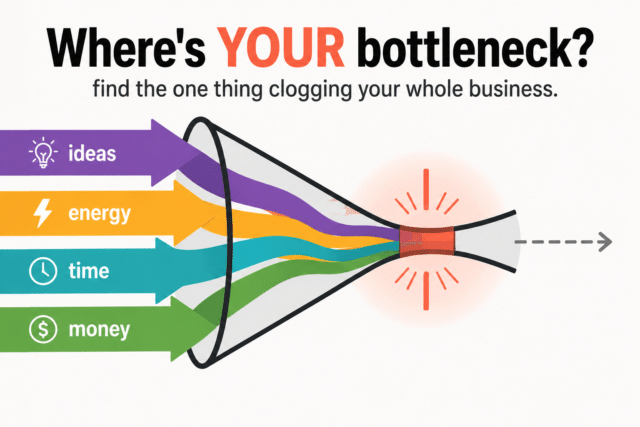
What the pile is really telling you
ADHD brains often do great at the beginning. New idea, fresh energy, big spark, lots of movement. Then novelty drops, the work gets fiddly, repetitive, or boring, and the project lands in the hardest part: the middle.
That's not random. It's predictable.
And once something is predictable, you can build around it.
The reason audits feel awful is not because they take so much time. It's because sitting down with unfinished projects can feel like getting lectured by your own brain. Every file has a feeling attached to it. Guilt. Grief. Dread. That low, annoying hum of “I should have done something with this.”
So the first mental shift matters more than people think:
Your unfinished projects are inventory, not evidence.
That one sentence changes the job in front of you. You're not reviewing your worth. You're sorting business assets, half-assets, expired ideas, and loose ends.
Some emotions will still show up. That's fine. You don't need to wait until you feel calm and objective and perfectly regulated before you begin. You only need to expect what is likely to happen.
You might hit rejection sensitivity and think, “This proves I'm bad at this.”
You might feel overwhelmed because there are too many projects and no obvious place to start.
You might slide into perfectionism and think, “If I can't do it right, I shouldn't touch it.
You might hit decision fatigue and feel blank, like every option is equally hard.
All of that can happen, and you can still do the audit. The system is there to carry some of the weight when your brain wants to turn the whole thing into a character judgment.
Set up the audit before your brain runs off with you
This part matters because ADHD audits go sideways in a very predictable way.
You open one unfinished project. Then you remember what you meant to do with it. Then you get excited. Then you spend three hours rewriting the sales page, renaming the folder, changing the colors in Canva, or fixing one tiny thing that was never the point of the session.
Now the audit is gone, your energy is gone, and the pile is still sitting there.
It's the sock drawer problem. You mean to straighten one drawer and somehow end up with the closet emptied, the bed covered in random stuff, and your whole room looking worse than when you started.
So put the audit in a container.
- Set a timer for 60 to 90 minutes. That is enough time to make decisions without disappearing into side quests.
- Pick one way to capture decisions. Use a Google Doc, spreadsheet, sticky notes, or a piece of paper. It does not need to be elegant. It needs to exist.
- Make one clear agreement with yourself: today is for decisions, not completion.
That third rule is the one that saves the whole thing.
If you catch yourself working on a project during the audit, stop and write a note instead.
Not “finish this quick part.” Not “while I'm here, I might as well.” Not “this will only take five minutes.” Your brain is lying. Five minutes turns into an hour, and the audit dies right there.
The goal today is not to clean up your whole business. The goal is to sort the pile so every project has a next destination.
And one more thing: there is no secret fifth bucket called “I'll think about it.” That is not a bucket. That is where projects go to haunt you forever.

Use the 4 buckets to sort every project
Every project you review has to land in one of four places. That's what keeps the audit clean.
This quick table makes the framework easy to scan.
| Bucket | When it belongs there | What happens next |
|---|---|---|
| Finish It | It still matters and you can see a path forward | Put it into your active workflow |
| Park It | It's a good idea, but the timing or energy is wrong | Set a review date and move it out of sight |
| Kill It | It no longer fits, or the moment has passed | Archive or delete it |
| Clarify It | You need one answer before you can decide | Get that answer within 48 hours |
The point is not to find the perfect answer. The point is to stop letting unfinished work sit in limbo.
Finish It
A project goes in “Finish It” when it is still worth completing, still tied to a current goal, and still has a visible path forward.
Not a fantasy path. A real one.
If you know why it matters and you can name what needs to happen next, it belongs here.
Park It
“Park It” is for good ideas with bad timing.
Maybe the concept still makes sense, but you don't have the energy for it right now. Maybe another project has to happen first. Maybe it's a strong idea for a different season of your business.
Parked is not dead. Parked is resting.
That only works if you treat it like a real status, not a prettier name for avoidance.
Kill It
This is the bucket people resist, and it's usually the one that gives the most relief.
A project goes here when the moment passed, the offer didn't land, your interests changed, your business changed, or you wouldn't choose it again today. It is done because it no longer fits, not because you failed.
Some ideas expire. That's normal.
Clarify It
This is the honest “I don't know yet” bucket, but it has rules.
A project can only stay here if there is one question standing between you and a real decision. One. Not five. Not a fog bank.
If you're staring at something and can't even name the question, it probably doesn't need more thought. It probably needs to be killed.

Ask the five questions that cut through the noise
You do not need a long soul-searching process for every single project. You only need enough information to place it in the right bucket.
These five questions do that fast.
- Does this still serve a goal you have right now?
Not the goal you had eight months ago. Not the goal you think you should have. A current goal. If the answer is no, you're usually looking at “Kill It” or “Park It.” - Did it stall because something was missing, and do you have that now?
That's a different situation from “I don't care about this anymore.” A project that got stuck because you lacked a piece of information, a tool, or capacity may still be alive. - Are there consequences if you don't finish it?
Some unfinished work is annoying. Some unfinished work affects revenue, delivery, client experience, or deadlines. Those are not the same. - Would you start this today, knowing what you know now?
This is the ruthless one. If you wouldn't begin it again today, pay attention. That tells you a lot. - What will it really take to finish, and is it worth that cost?
Not the fantasy version. The real version. Time, energy, attention, decision-making, coordination, cleanup. Is the result worth the drag?
You don't have to answer all five every time. Usually one or two will do the job.
A project tied to an old business direction may be finished in your mind before you even get to question three. A good idea with bad timing might move into “Park It” the second you realize the goal is still current, but your bandwidth isn't.
If you want more structure around planning and follow-through after the audit, Project Planning for ADHD Business Owners offers practical ideas like body doubling, accountability, and visual planning. That's useful when your problem isn't choosing the bucket, it's getting the finished project across the line.
Kill it without guilt, and park it without creating another pile
These are the two buckets that cause the most wobble.
Killing a project is not failure
A lot of people hear “Kill It” and think “give up.”
That makes sense if you've spent years hearing that you don't finish, don't follow through, or always lose interest. Then killing a project can feel like handing your inner critic one more piece of evidence.
But that's the wrong frame.
Every project taught you something. Maybe it taught you what your audience does not want. Maybe it taught you that you hate creating video and would rather write. Maybe it showed you that the idea only sounded good when you were tired, over-optimistic, or chasing someone else's business model.
That is not wasted time. That's data.
And data can save you from sinking more time into work that no longer belongs in your business.
When you kill a project, you clear space in more than one place. You clear mental space, because you're not carrying the open loop anymore. You clear calendar space, because it is no longer lurking in the background as a thing you “should” get back to. You clear hard drive space, too, which sounds small until you realize how much dread can live inside a messy folder structure.

Parking only works if you do it properly
Bad parking is fake progress. It looks responsible, but it leaves the guilt intact.
Good parking has three non-negotiables:
- Write down why you're parking it. Future you will not remember what past you meant. Note what is missing, what has to happen first, or why now is not the time.
- Give it a review date, ideally 60 to 90 days out. If there is no date, it isn't parked. It's lost.
- Move it out of your active workspace. Put it in a separate folder, drawer, or project list so you stop seeing it every day.
That last one matters more than people think. If a parked project stays in your face, you're not giving your brain any relief. You're keeping the tension alive.
You want to be able to revisit it later with fresher eyes, not with the stale guilt of seeing it every morning.
Turn the audit into action
This is the part where people can accidentally create a second wave of overwhelm.
You finish the audit, look at the “Finish It” list, and panic because there are six things on it.
Don't do all six. Don't even plan all six.
Pick one.
Choose the project with the most momentum, the clearest path, or the biggest immediate effect on your business. Then put that project into whatever system you already use for getting work done.
The rest of the buckets need closure, too:
- “Finish It” projects go into active work, one at a time.
- “Park It” projects get review dates before you close your laptop for the day.
- “Kill It” projects get archived or deleted, not shuffled into a different folder where you'll still trip over them.
- “Clarify It” projects get a 48-hour deadline to answer the one question holding them up.
That 48-hour limit is not random. Open questions can stay open forever if you let them. Two days is enough time to get the answer, make the call, and move the project into one of the other three buckets.
If you're building a stronger follow-through system after this, the Finish What You Start toolkit for ADHD entrepreneurs is another useful resource. The big idea lines up with this audit: your unfinished projects give you information about your friction points, and that information can shape better systems.

Did you know I have a membership for women who want to improve their executive function skills? Check it out here.
Make the audit a quarterly habit
This audit isn't a one-time fix.
Your pile will come back, because your brain is still your brain. You'll keep having ideas. You'll keep starting things. Some of them will still stall.
That isn't a flaw you need to eliminate. It's a reality you need to manage.
The win isn't “I cleared the pile once.” The win is “I have a repeatable way to deal with the pile before it becomes a shame monument.”
A 90-day rhythm works well for this. Set aside an hour every quarter. Open the list. Run the four buckets. Reset.
Over time, the process gets easier because your decisions get cleaner. You stop carrying as many old maybes. You get faster at spotting what still fits and what needs to go. You also build trust with yourself, not because you suddenly finish everything, but because you know you won't let unfinished work rot in the background for another year.
The pile is not the problem
You don't need to turn into someone who never starts messy, never changes direction, and never leaves anything at 80 percent. You need a system that can hold the reality of how you work.
Once you stop treating unfinished projects like evidence against you, the next move gets much simpler. Sort them. Finish what still matters. Park what needs to wait. Kill what is done. Clarify what has one real question left.
That pile loses a lot of power when every project has somewhere to go.