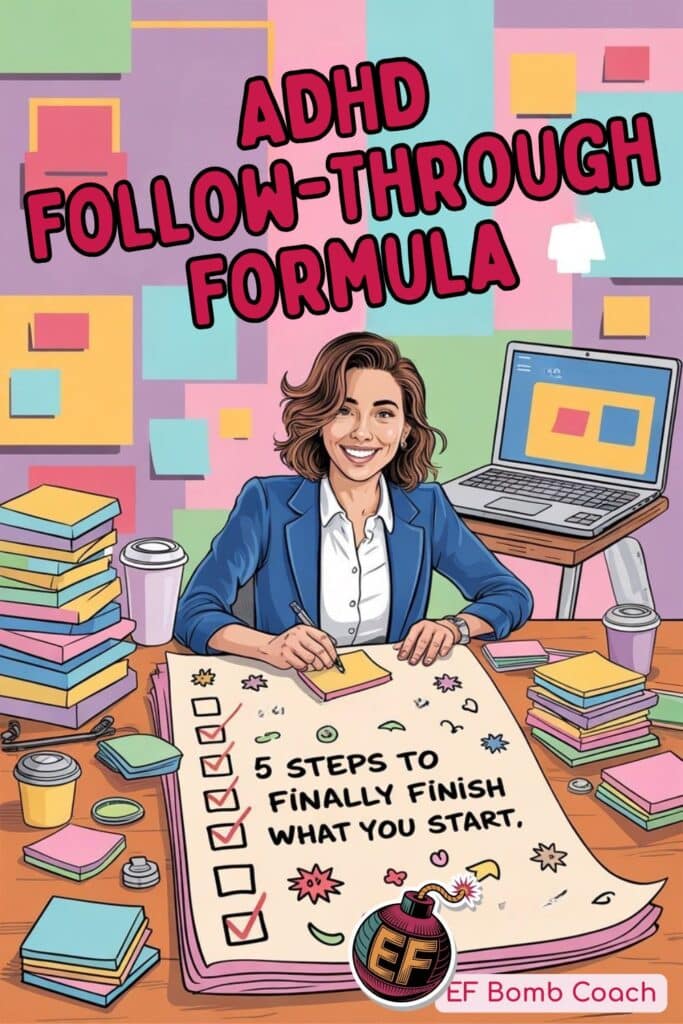
ADHD Follow-Through Formula: 5 Steps to Finish What You Start
You can care about a task, plan for it, and still freeze when it's time to finish. That gap between intention and action can feel personal, especially when the task looks simple on paper.
With ADHD, follow-through often breaks in the same few places. When you know where the stall happens, you can build a process that helps you move again.
Why follow-through breaks down with ADHD
Trying harder usually doesn't fix follow-through. If effort alone solved this, you would have solved it already. What helps more is a repeatable process you can use when a project gets sticky, boring, vague, or bigger than it seemed at first.
That matters because most advice about getting things done assumes a neurotypical brain. You hear “break it into smaller steps” and “do it later,” but those ideas often fall flat when you live with time blindness, task dread, and a brain that turns a 10-minute job into a four-hour monster before you even begin.
This struggle is common for ADHD business owners.
Follow-through gets easier when you change the conditions around the task.
Once you stop treating the problem like a character flaw, you can build around the places where your brain tends to lose traction.
The 5-step follow-through formula gives you options
The formula has five parts: shrink it, anchor it, borrow the momentum, build in the break, and make it count. You don't need every step every time. Some projects need the full setup. Others need one or two changes before you can move.
That flexibility matters. When you're stuck, the worst feeling is staring at a blank screen and thinking you “should” be able to do this by now. A menu of options gives you something to reach for instead.
This quick table gives you the full picture before you use each step in real life.
| Step | What it does | Simple example |
|---|---|---|
| Shrink it | Makes the task small enough to start | Write one sentence |
| Anchor it | Ties the task to a real moment | Do it after lunch |
| Borrow the momentum | Uses outside motion to help you begin | Work beside someone on Zoom |
| Build in the break | Sets a clear stopping point | Work for 20 minutes, then stop |
| Make it count | Helps your brain notice completion | Check it off on paper |
The main shift is simple. You stop waiting for the perfect mood and start building conditions that make action easier.
Shrink the task until your brain stops arguing
Breaking a task down helps, but ADHD often needs one more step. The task has to get so small that it feels almost silly. That's the point.
Your brain often reacts to the imagined version of a task, not the real one. “Write the email” can feel heavy because your mind fills in all the extra work around it. You imagine finding the right words, handling replies, making it perfect, and maybe dealing with feelings you do not want to deal with. No wonder you avoid it.
A smaller target changes the whole experience. Instead of writing the email, you write the first sentence. Instead of filming the video, you open the doc and read it out loud once. Instead of finishing the whole module, you record 10 minutes and stop.
Sometimes the smallest version is even more basic:
- Open your laptop.
- Open a Google Doc.
- Name the file.
- Type a rough title.
That may sound too small to matter. Still, starting is often the hardest part. Once motion begins, your brain has something concrete to work with. Friction drops. Momentum has room to show up.
Use silly small on purpose. If a task keeps sitting there, it is still too big.
Anchor the task to a real moment in your day
“Later” is not a time your brain can hold onto. It floats. Then it disappears.
Anchoring gives the task a hook. Instead of promising yourself you will do something at some point, you tie it to a moment that already exists. That could be after lunch, right when you sit at your desk, or during the five minutes before your next call.
This works because existing routines already have movement. You are not building a whole new system from scratch. You are attaching one action to something that is already happening.
For example, if you always make coffee before opening your inbox, the anchor can be simple: after coffee, write the first sentence of the proposal. If you log into Zoom a few minutes early for client calls, your anchor can be: before the call starts, update the notes from yesterday.
Specific anchors beat broad intentions. A real moment gives your brain something it can track. It also cuts down on the constant re-deciding that drains energy during the day.
If follow-up is a pain point in your business, you may find helpful ideas in this system for the ADHD follow-up problem. The core idea is the same: visible, fixed points work better than vague promises.

Borrow momentum instead of waiting for motivation
Motivation often shows up after you begin, not before. If you keep waiting to feel ready, you can lose days to the wait.
Borrowing momentum means using outside structure or nearby action to help your brain catch. Body doubling is a strong example. When another person is present, even quietly on Zoom, it can be much easier to stay on the task in front of you. You do not need a long conversation. Their presence helps hold the shape of the work session.
Social accountability can help for the same reason. When you tell someone what you plan to finish, the task gets a little more real. That small dose of urgency can be enough to get you moving.
You can also borrow momentum from yourself. If you are already in a productive window, stack the next task right there instead of saving it for a later slump. Or give yourself a short runway. Start with one easy action first, then slide into the harder one while your brain is already awake.
This step helps when motivation feels unreliable. You are not forcing yourself to produce it on demand. You are setting up a situation where it has a better chance to appear.

Did you know I have a membership for women who want to improve their executive function skills? Check it out here.
Plan your stopping point before the messy middle
Most projects do not die at the start. They die in the middle.
At first, a task may feel fresh. Later, the newness wears off. The end still feels far away. Your brain gets restless, and suddenly anything else looks better. That is where all-or-nothing thinking kicks in. You either finish perfectly or you feel like you failed.
A better plan is to decide two things before you start. First, define what done enough looks like for the next round. Second, decide when you will stop based on time, not based on whether the whole project is complete.
That might sound like this: “I am going to draft the opening section and stop after 25 minutes.” Or, “I will record 10 minutes and save the rest for tomorrow.”
This protects you in two ways. It lowers the pressure to make everything perfect in one sitting. It also turns stopping into part of the plan, not a sign that you quit.
You do not need to earn rest by crossing the whole finish line. Often, you need a safe stopping point so the project survives long enough to be finished later.
Make finishing feel real to your brain
Some ADHD tasks feel strange when they are done. You complete them, cross them off, and feel almost nothing. Then your brain moves on as if the work never happened.
That can make follow-through harder over time. If your brain does not register completion as rewarding, it has less reason to seek that finish again.
A small completion ritual helps. The ritual does not need to be dramatic. It only needs to connect the end of the task to a clear signal that says, “That counted.”
You can say “I did that” out loud. You can check the task off on a physical list, because the motion matters. You can take a short walk, make a good cup of coffee, or give yourself five minutes with something you enjoy.
The key is connection. The reward should happen after the finish, not after the attempt. Over time, that teaches your brain that finishing has value.

Put one stalled task through the formula today
This works best when you use it on a real task, not when you admire it as a nice idea.
Pick one thing that has been sitting on your list. Choose something half-done, delayed, or easy to avoid. Then write out your answers to these five prompts:
- What is the tiniest version of this task?
- When will you do that tiny version?
- What will help you get started?
- What counts as done enough for this round?
- What will you do right after you finish?
Write those answers somewhere you can see them. Use paper, your notes app, your planner, or the tool you already trust. Memory is shaky support for ADHD follow-through. A visible plan is much more useful.
The biggest shift happens when you get it out of your head and into your day. Once the task has a size, a time, a start cue, a stopping point, and a finish signal, it stops being a cloud and starts being a plan.
Follow-through feels different when the system fits your brain
The task that keeps getting pushed off is not always too hard. Often, it is too vague, too open-ended, or too far away from anything your brain can grab.
When you shrink the task, anchor it, borrow momentum, plan your stopping point, and mark the finish, follow-through becomes much more doable. You are giving your brain handles.
Start with one stalled task today. A small plan that fits your brain will carry you farther than another promise to try harder.