Why Pushing Harder Makes ADHD Focus Worse (and What to Do Instead)
You sit down to work, open your to-do list, and then… nothing. An hour passes, you're still staring at the screen, and the only thing that's gotten louder is the voice in your head asking, “What's wrong with me?”
If that hits close to home, you're not alone, and you're not broken.
When you “should” be able to focus, but you can't
From the outside, it can look like procrastination. You're at your desk. You have the time. You know the task matters. So why can't you start?
That's where a lot of ADHD shame gets its grip. You don't just feel stuck, you feel confused about being stuck. Then you pile on pressure, because pressure is what you've been taught to use.
You might recognize some of these thoughts:
- Just try harder.
- You'd get it done if you really wanted to.
- Everyone struggles with focus, you're just not disciplined enough.
- Other people can do this, why can't you?
Those lines sound like motivation, but they often turn into self-criticism. And self-criticism has a cost. It adds stress to a brain that already struggles with regulating attention, which makes it even harder to access the skills you need to get moving.
The myths about ADHD focus that keep you blaming yourself
A lot of advice about focus assumes you have the same “fuel system” as someone without ADHD. When that advice doesn't work, the conclusion usually becomes personal: I'm lazy. I'm undisciplined. I must not want it enough.
That story is popular, but it's wrong.
The myths you've heard your whole life
These myths are common because they sound reasonable, and because you've probably heard them for years:

- Just try harder.
- You'd get it done if you really wanted to.
- Everyone has problems with focus.
- You're not trying hard enough.
- You're not disciplined enough.
The most damaging part is how believable they feel in the moment. You look at the evidence (another unfinished task, another late night scramble), and it's easy to decide the problem is you.
The truth: ADHD is about regulating attention, not “having none”
ADHD isn't about lacking attention across the board. It's about regulating attention, which is a very different problem.
When your brain can't consistently control where attention goes, what it stays on, and when it switches, you get that maddening pattern: you can focus intensely sometimes, and other times you can't focus at all.
If you want a science-backed overview of the brain differences involved, ADDA has a helpful breakdown in Inside the ADHD Brain: structure, function, and chemistry. It reinforces the core point: your brain isn't “bad,” it's wired differently.
Your brain isn't broken. It's different, and it needs different conditions to work well.
That's not an excuse. It's a starting point.
What's actually happening in your ADHD brain
When focus disappears, it's tempting to treat it like there's something WRONG with you. In reality, several brain systems can be underactive or out of sync, especially when the task is boring, unclear, or not urgent.
There are three big players: the prefrontal cortex, dopamine, and norepinephrine. When these aren't cooperating, “just start” isn't a strategy, it's a demand your brain can't meet on cue.
Your prefrontal cortex, your brain's project manager
Your prefrontal cortex sits right behind your forehead. It's where a lot of executive function lives, the skills that help you plan, focus, begin tasks, and manage impulses.
Think of it like your brain's project manager. It decides what matters right now, breaks work into steps, and helps you start even when you don't feel like it.
With ADHD, that area often shows lower activation, especially when the task doesn't have built-in urgency, novelty, or interest. So if the work is routine, long-term, or plain annoying, your “project manager” is more likely to go quiet.
That's why you can care deeply about something and still struggle to begin. Caring isn't the same as activation.
Dopamine, the “let's go” chemical that doesn't drip steadily
Dopamine gets talked about a lot in ADHD conversations, but the practical takeaway matters most: dopamine helps your brain feel engaged and motivated.
Think of it this way:
- Neurotypical brains often get a steadier drip.
- ADHD brains can feel like a faucet that's mostly off, then blasts when something is interesting.
That difference changes everything about how motivation works day to day.
Neurotypical vs. ADHD motivation triggers
When dopamine spikes, focus can snap into place. Common triggers include:
- Urgency (a deadline is real and close)
- Novelty (it's new)
- Challenge (you get to solve a problem)
- Intrinsic interest (you genuinely care)
When those ingredients are missing, your brain may struggle to “turn on,” even if the task is important.
Interest-based motivation vs. importance-based motivation
This is the part many people miss: ADHD brains tend to run on interest-based motivation, not importance-based motivation.
So yes, you can know something matters. You can want the result. You can even fear the consequences. Yet the task still won't start because your brain can't create the internal “go” signal without enough interest, novelty, or urgency.
Norepinephrine and the alertness dial
Norepinephrine helps regulate attention and alertness. When it's underactive or out of balance, it's harder to stay tuned in, especially on tasks that are quiet, repetitive, or mentally slippery.
Put those three together (prefrontal cortex, dopamine, norepinephrine), and the “why can't I focus?” question starts to have a real answer: your brain may not be getting the chemical and executive support it needs to engage right now.

Why “do the boring tasks first” can fail with ADHD
You've probably heard advice like, “Do the hardest thing first,” or “Eat the frog.” I've made these suggestions, too, because for some people, it works. They feel relief once the dreaded thing is done. The nagging goes away, and the rest of the day feels lighter.
But for others, that advice can land like a setup.
When a task doesn't create enough motivation fuel, your brain can't reliably manufacture focus just because you told it to. That's why “try harder” often turns into a spiral:
- You can't start.
- You push harder.
- You get stressed.
- Stress makes focus worse.
- You blame yourself for step 1 again.
This is one reason it's a dopamine problem, not a willpower problem. Willpower doesn't fix a brain that can't access its “start engine” on demand.
How stress and cortisol make ADHD focus worse
Pushing harder sounds like it should help. Still, if “pushing harder” includes self-criticism, it can shut down the exact part of your brain you need.
The cortisol flood from beating yourself up
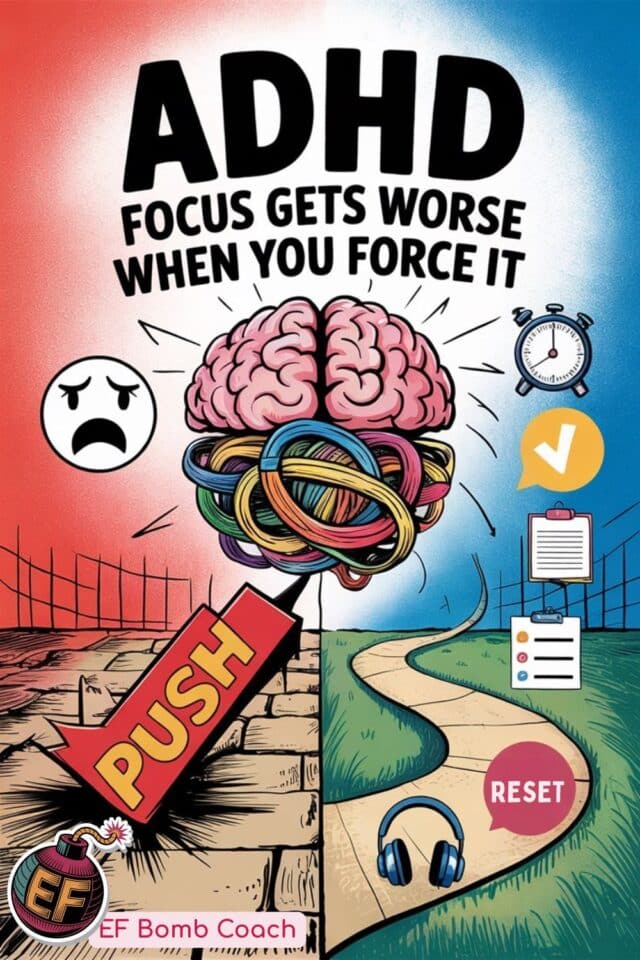
When you tell yourself you're lazy, stupid, or broken, your body reads that as stress. Stress increases cortisol. Cortisol can suppress clear thinking and make it harder to access executive function.
If you've ever felt like you “know what to do” but suddenly can't think straight, this is a common reason. This is “flipping the lid,” meaning you can't access the tools in your prefrontal cortex when stress takes over.
In other words, the cruelty of “try harder” is that it often creates the very state that blocks focus.
When you pile shame on top of ADHD, you're not adding motivation, you're adding a handicap.
Five reasons you look “lazy” when you're actually stuck
Understanding the pattern matters because different problems need different solutions. If you label everything as laziness, you'll keep trying the same fix: yelling at yourself to start.
Here are five common focus blockers, and what they can look like in real life.
- Task initiation challenges
You know what to do. You might even want to do it. Yet starting feels like trying to lift a car with your hands. This is often the moment you freeze at your computer, stuck between intention and action. - Working memory overwhelm (too many tabs open)
Your brain tries to hold everything at once: this task, the next task, the idea you don't want to forget, the email you should reply to, the errand you need to run. That mental “tab overload” makes it hard to focus on the one thing in front of you, because your brain keeps scanning for what it might drop. - Time blindness
Time blindness means your brain doesn't register time the same way other people seem to. Long deadlines don't feel real, so starting early can feel pointless. Then, suddenly, the due date is close and panic kicks in. If you remember school projects that felt far away until they were two days from due, you've seen this pattern before. Research summaries like Time perception in adult ADHD describe how real and persistent this can be. - Sensory overload
Lights, sounds, smells, background movement, notifications, clutter in your line of sight, it can all compete for your attention at once. When your brain can't filter it well, focusing becomes exhausting. It's not that you “should just ignore it,” it's that your brain is receiving too much input. - A dopamine drought
When there's no urgency, novelty, challenge, or interest, your brain may not get enough of that “let's go” signal to engage. You can still care about the outcome, but the task itself doesn't spark the chemistry that helps you start.
Once you can name which one is happening, you can stop treating every moment of stuckness like a moral failure. You're not trying to win an argument with your brain. You're trying to work with it.

Did you know I have a membership for women who want to improve their executive function skills? Check it out here.
Hyperfocus isn't proof you're faking, it's a clue
You've probably had the “plot twist” experience: one day you can't answer an email, and another day you fall into a rabbit hole for six hours and forget to eat.
Then someone says, “See? You can focus when you want to.”
That comment hurts because it points to something real: you can focus intensely. The missing piece is why.
Hyperfocus often happens when the task has the right ingredients: interest, urgency, novelty, challenge. Your brain gets a dopamine boost, then locks in. It's the same brain, just under different conditions.
Hyperfocus doesn't mean you're choosing inconsistency. It usually means your brain is responding exactly as it's wired to respond.
Stop blaming yourself and build a new map that fits your brain
At a certain point, the biggest shift is this: you stop diagnosing your focus struggles as a personal defect.
Instead, you ask a more useful question: “What does my brain need right now?”
Sometimes the answer is urgency. Other times it's novelty, a clearer next step, fewer distractions, or a way to make the task feel more interesting. The goal isn't to “fix” you. It's to build conditions that let your brain engage more often.
Replace the old script with a better one
The old script says: “If you cared, you'd push harder.”
The new script sounds more like: “My brain needs the right fuel, so what can I change about this task or this moment?”
That shift matters because it takes you out of shame and into problem-solving, which is where many ADHD brains do well.
The fixable truth you need to hear
You've been handed a map for doing life that was never drawn for your brain. No wonder it feels like you're constantly lost.
You don't need more punishment. You need a new map, one you can actually follow.
If pushing harder has made your focus worse, it's not because you're weak. It's because stress shuts down the systems you need, and ADHD motivation doesn't run on importance alone.
When you stop calling it laziness and start asking what your brain needs, you give yourself a real chance to move forward. Keep the truth front and center: your brain is different, and that difference is workable. What's one task you've been stuck on that might change if you added interest, urgency, or a clearer next step?