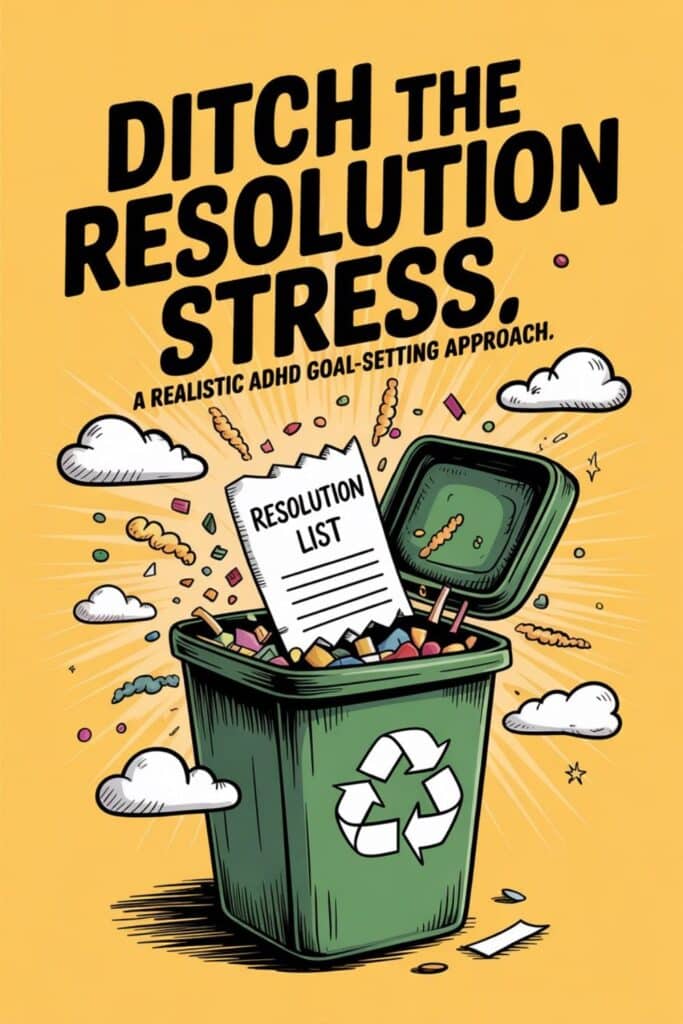
Anti-Resolution Revolution for ADHD Women (Tiny Habits That Stick)
You know that rush you get from a brand-new notebook in January. Fresh pages, smooth cover, favorite pen, and that hopeful title on page one: “New Year, New Me.”
You write 10 huge goals. You color-code them. You swear this is the year everything changes.
For a few days, you are on fire. You wake up early, you drink the water, you write the content, you hit the gym, you do the things.
Then real life shows up. Client emergencies, kids, launches, hormones, random insomnia, brain fog. You miss a day, then three, then a week. That hopeful energy crashes into the old familiar thought:
“What's wrong with me?”
If you live with ADHD, this hits even harder. You're not just tired of failing at resolutions. You're tired of what you tell yourself after you “fail.”
The anti-resolution revolution is your way out of that cycle. Instead of one huge, shiny promise in January, you build tiny, honest, flexible habits that actually fit your real life, your real business, and your real brain.
Why Resolutions Keep Making You Feel Like a Failure
Resolutions look good on paper because they're built for your fantasy self.
Fantasy you wakes up at 5 a.m., loves salads, never forgets anything, and runs her business like a machine. Fantasy you isn't real. Real you has ADHD, a human body, moods, and a limited amount of executive function each day.
That mismatch is the trap.
Picture it:
You write big goals like:
- “Get in the best shape of my life.”
- “Wake up at 5 a.m. every day.”
- “Read 50 books this year.”
- “Never eat sugar again.”
These sound impressive. The problem is not that the goals are bad. The problem is that there is no system underneath them.
No step-by-step, no safety net for hard days, no room for being human.
So the moment you hit a bad week, your brain quietly swaps the thought “I skipped a workout” for “I am a failure.”
Research backs this up. One summary from Ohio State University notes that only about 9 percent of people actually complete their New Year’s resolutions, which lines up with what many mental health experts see in practice. You can read more about that in this breakdown of why most New Year’s resolutions fail.
It's not that people are lazy. It's that the structure is fragile.
Here are four big reasons those resolutions fall apart:
- Built on fantasy, not data
You set goals for the version of you who never gets tired, never gets distracted, and has zero logistics to manage. You ignore your actual schedule, energy patterns, stress load, hormones, and responsibilities. When fantasy goals collide with real life, real life always wins. - Too big and too vague
“Get healthy,” “be more organized,” or “fix my life” are not plans. Your brain, especially your ADHD brain, needs clear, concrete actions. If you can't answer, “What exactly do I do today?” your goal is still foggy. - All-or-nothing mindset
Resolutions often sound like laws: “I will work out every single day,” “I will never scroll at night again.” The first time you miss, the inner critic shows up and says, “See, you never stick with anything.” Instead of doing a small version, you quit and pile shame on top. - The calendar trick
We act like January 1 has magic baked into it. It doesn't. If your system only works on a fresh-start date, it's not a system. Real change works on a random Tuesday in March when you woke up late and you're already behind.
If you see yourself in this, you're using a goal style that is hostile to how your brain and your life actually work.

The Core Shift: Small Wins All Year Long
The anti-resolution revolution isn't about hating goals. It is about changing how you build them.
Instead of trying to become a whole new person overnight, you start acting like someone who improves in small ways all year long.
You stop grading yourself on perfect streaks and start tracking something much more realistic: showing up routinely.
That might look like:
- Doing something three days a week instead of seven
- Coming back after a rough week instead of quitting the whole month
- Allowing “tiny versions” instead of full-out effort every time
Consistency is not “I never miss.” Consistency is “I come back.”
To make that real, you lean on three core ideas.
Core Idea 1: Tiny Non-Dramatic Habits
Trade the giant, dreamy goals for tiny actions that look almost too easy.
Instead of:
- “Work out 6 days a week,” you do 10 squats after brushing your teeth.
- “Read 50 books this year,” you read one page before you check your phone.
- “No sugar ever again,” you start with no pop on the weekends.
Your ego hates this. It loves “dramatic” change. It wants the 30-day challenge and the perfect 5 a.m. routine and the 12-week body plan.
But tiny habits are built for the days when:
- You slept terribly
- A client launch blew up
- Your period showed up early
- Your kid was up all night
- Your ADHD brain is tired and foggy
The rule: make the habit so light that the real you can do it on your worst day.
If you want more ideas that respect ADHD energy and attention, you might like the strategies in this guide to creating habits with ADHD, which echoes the same focus on small, repeatable actions.
Core Idea 2: Flexible Rules, Not Strict Laws
Traditional resolutions sound like the Supreme Court of Your Life. Anti-resolution habits act more like guardrails on a road trip.
You create guidelines that shape your day without trapping you:
- On weekdays, you move your body for at least 5 minutes.
- On workdays, you write for 10 minutes before you open social media.
- On Sundays, you plan your top three tasks for the week.
These rules flex with real life. If you are sick, burned out, or traveling, you can swap in the tiniest version and still keep your word to yourself. You're building a supportive container, not a prison.
Core Idea 3: Identity-Based Change
Instead of staring at outcomes like “lose 20 pounds” or “hit 6 figures,” you start with a deeper question:
Who do you want to become?
For example:
- “I want to be someone who keeps promises to myself.”
- “I want to be the kind of person who moves every day.”
- “I want to be a calm planner, not a last-minute firefighter.”
From there, you match small actions to that identity.
“I am the kind of person who moves every day” might mean:
- Walking around the block after lunch
- Stretching for 3 minutes between calls
- Doing 10 squats while your coffee brews
Writer James Clear calls these identity-based habits, where every tiny action is a “vote” for the type of person you want to be. You can go deeper into that idea in his guide on identity-based habits.
Identity change gives your habits a home. You are not just chasing a number on a scale or in your Stripe account. You are becoming a different version of you, one small choice at a time.

Your 4-Step System to Build Habits That Stick
Now it's time to turn this into something practical you can use in your business and life. Think of this as your four-step anti-resolution system.
Step 1: Pick One Area to Upgrade
Your ADHD brain loves options. It also gets overwhelmed by them. Instead of trying to optimize your health, business, home, finances, and relationships all at once, ask:
“What is one area of my life that would feel 10 percent better with a small upgrade?”
Maybe that is:
- Morning focus so you stop doom-scrolling before work
- Moving your body so you have more energy for your clients
- Planning your week so you are not constantly firefighting
Start with one. When that habit starts to feel automatic, you can add another.
Step 2: Shrink the Goal Until It Feels Silly
Write out the dramatic version first. This is probably what you’d write in that shiny January notebook.
Then shrink it.
For example:
- Big goal: “Go to the gym 5 times a week.”
- Shrink once: “Move my body every day for 20 minutes.”
- Shrink again: “Walk outside for 5 minutes.”
If “walk outside for 5 minutes” still feels heavy on a hard day, shrink it one more time:
- “Put on my shoes and stand on the porch.”
You want the version that makes you think, “That barely counts.”
That's the point. When your brain is fried, “barely counts” is what still happens.
Coach and writers in the ADHD space talk a lot about how powerful this is. The team at Tiny Habits Academy shares examples of this approach in their article on tiny habits for reducing ADHD overwhelm, which fits perfectly with this small-steps mindset.

Step 3: Attach It to Something You Already Do
Here's where you stop relying on motivation and start using structure. You glue your new habit to something you already do every day. This is often called habit stacking.
For example:
- After you brush your teeth, you do 10 squats.
- After you sit at your desk, you open your planner and write your top three tasks.
- After you make your morning coffee, you read one page of a book.
The existing habit is your anchor. The new tiny action rides along.
This works well for ADHD brains because you're not asking your memory to hold one more loose item. You're using routines you already have as a built-in reminder.
If you want a deeper breakdown that is written with ADHD in mind, check out this explanation of habit stacking and its benefits for ADHD.
Step 4: Track Tiny Wins, Not Streaks
You will miss days. Some weeks will be chaotic. That's normal. Instead of trying to never miss, you track: “Did I show up at all?”
You can:
- Put a small check mark on a wall calendar
- Keep a simple list in your notes app
- Drop one paperclip in a jar every time you do the habit
Keep it low friction. The tracking should not become another project.
A useful guideline is “try not to miss twice.” Not as a harsh rule, but as the aim. If you miss one day, your job is to come back the next day with the tiniest version of your habit.
If you get sick and miss four days, that doesn't mean the system is broken. It means your body needed care. When you're ready, you ask, “What is the tiniest step I can take to restart?”
The win is not “I kept a perfect 60-day streak.” The win is “I restarted after a hard week.”

How to Bounce Back from Slip-Ups Without Shame
Slip-ups aren't proof that you can't change. They're part of the process.
To keep them from turning into full-on self-sabotage, use this three-step reset.
- Notice without drama
You say, “I stopped doing my habit this week,” and leave it at that. It is not a character judgment. It's just data. When you treat it as information, your brain stays calmer and more curious. - Ask one calm question
Instead of, “What is wrong with me?” try, “What got in the way?”
Was it time, energy, stress, hormones, kids, clients, your environment? There was a reason. Naming it helps you solve the right problem instead of attacking yourself. - Adjust without shame
If you didn't do the habit, it was probably still too big for the conditions you were in. Shrink it again. Make it even smaller and treat the next round like an experiment.
The story you tell yourself here matters.
Try shifting:
- From “I always quit” to “I am someone who restarts.”
- From “I have no discipline” to “I am learning systems that fit my brain.”
Your identity is shaped by what you repeat. You get to choose which lines you keep.
If you want more support on how habit structure affects your mind, this explanation of why New Year’s resolutions fail psychologically can help you see that this is about design, not personal weakness.
Take the 10-Minute Anti-Resolution Challenge
You don't need January 1, a vision board, or a perfect planner to start.
You need 10 minutes.
Here's your challenge. You can do this on your couch, at your desk, or in your car while you wait in the school pick-up line.
Minutes 1–2: Pick your focus area
Ask yourself: “Which area of my life or business would feel noticeably better with a 10 percent upgrade?”
Maybe it's:
- Morning focus
- Movement
- Planning your week
- Financial check-ins
- Marketing consistency
Write that area down.
Minutes 3–5: Write the big goal, then shrink it
Write the dramatic version that you’d normally call your resolution.
Then shrink it at least two times. If it still feels heavy, shrink it again. Aim for silly small.
Examples:
- “Post on social media every day” becomes “Spend 2 minutes opening the app and drafting one sentence.”
- “Have a spotless house” becomes “Clear one surface for 3 minutes after dinner.”
Minutes 6–8: Choose your anchor
Decide when this tiny habit will happen and what you will attach it to.
Is it:
- First thing after you wake up
- Right after you pour coffee
- After your last client call
- While you sit in the pickup line
- Right before you brush your teeth at night
Write the sentence:
“After I [current habit], I will [tiny new habit].”
Minutes 9–10: Do the first tiny version today
Do the smallest version right now.
One page. Five squats. One-minute tidy. Two-minute inbox skim. Whatever you chose.
You're not waiting for Monday, next quarter, or next year.

Did you know I have a membership for women who want to improve their executive function skills? Check it out here.
You Don't Need a New Year to Start
Resolutions aren't “bad” because you want change. You want change because you care about your life, your work, and your people. They feel harmful because of the way they're usually built. They pull you into a perfection trap, then blame you when perfection cracks.
You don't need a new year, a new planner, or a new version of you to begin. You need one tiny habit that fits who you are right now and the life you already have.
Start with one small promise. Keep it light, keep it flexible, and keep coming back.
Your slightly-better-every-day self is more powerful than “New Year, New Me” ever was.