
ADHD Time Blindness: Why Discipline Won’t Save You
If you've spent your whole life fighting with clocks, calendars, and deadlines, you're probably carrying a story that says you need more discipline. You don't.
Time blindness can make you feel flaky, irresponsible, or bad at adulting, when the real issue is that your brain doesn't track time the way standard advice assumes it should.
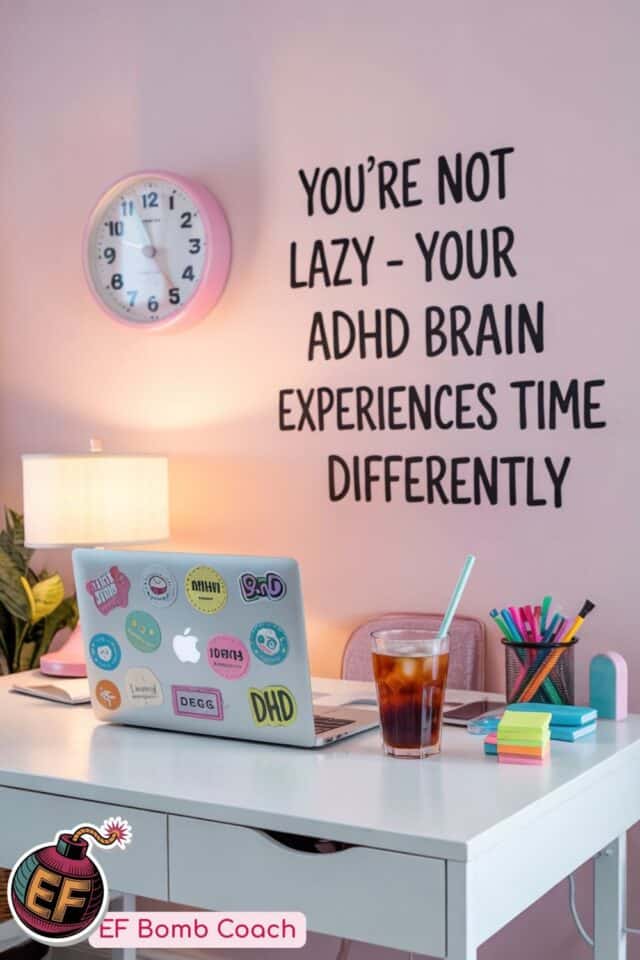
You're Not Lazy, Your Brain Sees Time Differently
“If you have struggled with time your entire life, you're not lazy, you're not irresponsible, and you're not bad at adulting.”
That's the starting point, and if you need to read that twice, do it.
You've set the alarms.
You've bought the planners.
You've built the color-coded Google Calendar that looked amazing on Sunday and was abandoned by Tuesday.
And every time it fell apart, that nasty little voice popped up: “Maybe the problem is just you.”
It's not you.
A lot of time-management advice is built for a brain that experiences time as steady, trackable, and easy to hold in mind. If your brain doesn't do that, the advice can feel fine in theory and useless in real life. That's why the system keeps breaking down, even when you care, even when you're trying, even when you're smart enough to know better.
The relief here is simple: once you stop treating this like a character flaw, the pattern starts to make sense.
ADHD Time Blindness Often Feels Like “Now” or “Not Now”
One of the clearest ways to understand time blindness comes from Dr. Russell Barkley's explanation of how time feels in ADHD. For a lot of people, time works like a continuous line. The past informs the present, and the future feels close enough to plan for.
For many neurodivergent brains, it doesn't feel like one long line. It feels more like two buckets.
Now. Not now.
That 3 p.m. meeting? Not now.
The Friday deadline? Not now.
Your kid's recital that starts in 20 minutes? Also not now, right up until it becomes very, very now.
If that sounds painfully familiar, that's because this isn't a mindset issue. It's neurological. You're not failing to care about time. You're having a hard time feeling time in a way that lets you act on it early enough.
What's happening under the hood
Time perception depends on a few brain systems working together. One is working memory, which helps you hold information in mind and use it in real time. Another is your brain's internal clock, the system that tracks the passage of time without you having to think hard about it.
In ADHD and other neurodivergent brains, those systems can be less reliable. Add dopamine into the mix, which affects motivation and time-sensitive behavior, and you get a brain that's trying to estimate time with a faulty measuring tape.
That's why you can be wrong about how long something will take without “trying” to be wrong. You're not making bad guesses on purpose. You're working with an unreliable instrument.
If you want the research side of this, this review of time perception in adult ADHD lays out how these patterns show up in adults.

What Time Blindness Looks Like in Your Business
Time blindness shows up in everyday life as running late, losing hours, or getting blindsided by deadlines. In business, it gets expensive.
Here are a few ways it tends to hit:
- You say yes to a project that feels like a 10-hour job, then realize it takes 10 hours in a week that was already full.
- You stack four client calls into a Tuesday because each one is “only an hour,” then forget about prep time, transition time, recovery time, and the fact that your brain is toast by 2 p.m.
- You set your own deadline for Friday, feel fine about it on Monday, then wake up shocked that Friday is somehow here.
None of that means you're careless. It means your planning is being built on top of a weak sense of time passing.
This is where a lot of smart business owners get stuck. You know how to do the work. You're capable. You're committed. But if time doesn't register in your system the way it does for other people, you can keep creating plans that look reasonable on paper and fall apart on contact with real life.
That mismatch creates shame fast. You start thinking you need a better planner, a stricter schedule, more willpower, more discipline. But the issue isn't that you don't want success badly enough. The issue is that your brain isn't naturally giving you the cues that those plans depend on.
Why “Try Harder” Usually Backfires
“Try harder” sounds simple, but it's asking your brain to do a bunch of high-level cognitive work at the exact moment those skills are already shaky.
Trying harder means using working memory.
It means sustaining attention.
It means holding your future self's needs in mind while your present self is busy, distracted, tired, stressed, overstimulated, or all of the above.
Discipline is not a magic fix when the brain systems behind time perception are already under strain.
That's why self-control is often one of the first things to drop when life gets messy. Not because you're weak, but because the system was overloaded to begin with.
This matters because so much advice about productivity assumes you can internally monitor time, motivate yourself on demand, and smoothly transition from one task to the next. If that's not how your brain works, then building your entire plan around self-discipline is like building a house on wet sand.
The better move is to stop treating internal tracking as the main tool. You need external systems.
That's not a backup plan. That's accurate problem-solving.
If you want a simpler, reader-friendly overview of the signs and coping patterns, this piece on ADHD time blindness gives a useful summary.
Make Time External Instead of Keeping It in Your Head
If your brain can't reliably track time internally, then the fix is to move time outside your brain.
This is the backbone of time management that tends to work better for ADHD. You make time visible, audible, or physical, so you don't have to keep estimating it from memory and hope for the best.
Make time visible
A digital clock tells you what time it is. A visual timer shows you how much time is left. That difference is huge.
When you look at a clock and see 1:15, you still have to translate that into something meaningful. How long do you have? How much can you finish? How close are you to needing to leave? That's mental work.
A visual timer cuts down that work. A Time Timer style clock or app shows time as a shrinking colored disk, so you can literally see time disappearing. Instead of holding “45 minutes” as an abstract number, you see the chunk getting smaller in front of you.
That visual cue can make time feel more real.
The same idea applies to your daily plan. If your schedule lives inside an app you never open, it may as well not exist. Writing your day on a whiteboard and keeping it in your line of sight means the plan is out in the world, where it can keep reminding you without you having to remember it first.
You don't need a prettier system. You need one your eyes can trip over.
Make time audible
Most people set alarms for when something starts. If transitions are hard for you, that alarm is already too late.
The alarm that helps most is often the one that goes off before the event. A 10-minute warning gives your brain space to wrap up, switch gears, and get moving before the next thing becomes urgent.
The label matters too.
An alarm that says “2:00 PM” forces you to remember why you set it. An alarm that says “Wrap up and prep for client call” does the thinking for you. The label carries the context so your brain doesn't have to.
That's a small tweak, but it matters. The fewer steps your brain has to fill in on its own, the better.
It also helps to use different sounds for different kinds of tasks. If every alarm sounds the same, your brain starts tuning it out. And if you're using the same sound for “wake up” and “switch tasks,” there's a decent chance your nervous system has already decided that noise is background irritation.
Give transitions their own sound. Give appointments their own sound. Make your cues easier to identify without thinking.
Make time physical
There is something about touching your schedule that makes it stick.
Some people do better with sticky notes on a wall, one task per note, removed one at a time as the day moves. Other people like index cards they can shuffle, stack, rewrite, or cross off with a pen. That physical action can make progress feel more concrete than tapping a checkbox on a screen.
And sometimes the most useful external support is another person.
Body doubling works because another human acts like an anchor for your attention. When someone else is there, even on a video call, time can feel more present. Your work has edges. The task has shape. The moment has accountability.
That doesn't mean you need someone supervising you all day. It means your brain often responds better to cues outside itself than to internal pressure.

Did you know I have a membership for women who want to improve their executive function skills? Check it out here.
Your One Job This Week
Don't overhaul your whole life by Friday. That's not the assignment.
Pick one externalization strategy and try it for five days.
Use a visual timer.
Set labeled transition alarms.
Write your day on a whiteboard.
Move tasks around on index cards.
Work next to someone for an hour.
The point isn't to find the perfect system in one shot. The point is to notice what changes when time stops living only in your head.
The Fix Is Support, Not Shame
When you keep losing track of time, it's easy to turn that into a moral story. You care less. You're trying less. You're worse at this than everyone else. That's the story time blindness loves to feed.
A better story is this: your brain needs more external support around time, so you build more external support around time. That's it. No shame required.
If one tool makes time easier to see, hear, or touch, that's not cheating. That's support, and support is what makes the work possible.