How to Shutdown Your Workday With ADHD
Do you ever close your laptop and still feel like you're working three hours later?
If you run a business with an ADHD brain, stopping work and finishing work are not the same thing. You can leave your desk, make dinner, help your kids, crawl into bed, and still have your brain writing emails in the dark.
A shutdown routine gives your brain a real ending, not a vague fade-out. That's where the relief starts.
Stopping work isn't the same as finishing your day
A lot of days don't end because you chose to end them. They end because you ran out of gas, somebody needed you, or the clock pushed you out. So you close the laptop. You walk away. But your mind doesn't.
That kind of ending leaves too much hanging. The task you didn't finish is still rattling around in your head. The email you meant to send is sitting in a mental draft folder. Tomorrow's next step isn't written down anywhere, so your brain keeps holding it, because if it lets go, it might disappear.
Here's the difference in plain English:
| When you abandon the day | When you finish the day |
|---|---|
| You stop because you have to | You stop on purpose |
| Unfinished tasks stay in your head | Unfinished tasks get captured somewhere safe |
| Tomorrow starts with confusion | Tomorrow starts with a plan |
| Your body stops working | Your brain gets the message that work is over |
From the outside, those two versions can look almost identical. In both cases, the computer is off. In both cases, you are no longer at your desk.
Inside your nervous system, though, they are not the same at all.
When you finish your day on purpose, you review what happened. You close a few loops. You write down what's unfinished. You pick a place to restart tomorrow. That tells your brain, “Nothing has to be held in active memory tonight.”
When you don't do that, your mind keeps the lights on. It keeps scanning. It keeps checking. It keeps rehearsing tomorrow, because nobody told it the shift was over.
If you've ever thought, “Why can't I relax when I'm technically done?” that's often the answer. You didn't fail to rest. You never got a clean stop.
Why your brain doesn't log off when the laptop closes
Working memory keeps unfinished business alive
ADHD brains tend to hold onto open loops. That means unfinished tasks, unanswered questions, decisions you haven't made, and ideas you don't want to lose.
Your brain tracks those things in the background whether you asked it to or not. It's trying to help. It does not want you to forget something important, so it keeps bringing unfinished business back to the surface.
Closing the laptop doesn't close the tabs in your head.
That's why walking away from your desk doesn't always feel like relief. You may be out of your chair, but part of your attention is still monitoring everything you didn't finish.
And no, that doesn't mean you're bad at boundaries. It means your brain doesn't trust that the information is safe anywhere outside of itself.
Hyperfocus, time blindness, and rejection sensitivity make it worse
Hyperfocus can make the end of the day feel abrupt. You get pulled into something and suddenly three hours are gone. There was no natural stopping point. No inner cue that said, “Wrap this up.”
Time blindness can make the day slippery in both directions. Sometimes the workday sneaks up on you. Other times it drags and drags, so stopping doesn't feel real. You keep thinking you should squeeze in one more task, one more email, one more fix.
Then there is rejection sensitivity. This one hits hard for a lot of neurodivergent business owners. Unfinished work doesn't feel neutral. It can feel personal. You don't only think, “That sales page isn't done.” You think, “Why couldn't I finish it?” or “I should have done more.”
Now your brain isn't only tracking the task. It's tracking the emotion attached to the task.
That's why some work follows you into the evening with extra force. It isn't only open. It feels loaded. Heavy. Like proof of something.
The more that happens, the harder it gets to switch off.

What an unfinished day costs you
The first thing you lose is the quality of your rest.
If your brain never got a clear message that work is over, it stays in low-level problem-solving mode. You may be watching TV. You may be lying in bed. Your body may be trying to wind down. Your mind is still editing tomorrow.
Your body is in bed. Your brain is still at the office.
That wears on your sleep. Then poor sleep hits your focus, your decision-making, your patience, and the executive function skills that already take more effort. So the next day starts harder, which makes it more likely you'll drag work into the next night too.
You also carry over decision fatigue. When you don't close the day, you don't start the next one fresh. You start with yesterday's loose ends already hanging off your shoulders. Before you've done a single task, you're already holding unresolved choices, half-finished work, and mental clutter.
That costs you creativity too.
Your brain needs real downtime to do deeper processing. It needs space where it is not on alert, not trying to remember everything, not stuck in review mode. If your mind never gets off duty, you lose some of that refill time. New ideas have a harder time showing up when the whole system is busy babysitting unfinished tasks.
What a shutdown routine changes in your brain
Your brain responds well to patterns. Repeat the same short sequence often enough, and your nervous system starts to recognize it.
That's what a shutdown routine is. It's not a fancy productivity ritual. It's a repeated cue that says, “Work is complete for today.”
When you review the day, capture what's unfinished, and choose tomorrow's starting point, you're doing two things at once. You're reducing uncertainty, and you're giving your working memory permission to let go.
That matters because your brain hangs onto open loops when it thinks it has to protect them. Once those tasks live somewhere reliable, your notebook, planner, task manager, or even a voice memo, your brain doesn't have to keep flashing them at you every twenty minutes.
This is why a trusted system matters. It doesn't have to be complicated. It has to be a place you will check again. If you need ideas for building routines that work with an ADHD brain, these adult ADHD daily routine examples make the point well: externalize what your brain keeps trying to hold.
A shutdown routine also creates a boundary.
Without one, the end of the day can feel mushy. You drift out of work. You don't really decide to stop. You fade. And that vague ending doesn't give your brain much to work with.
A real routine gives you a transition. A before. An after. Over time, the routine itself becomes the cue. Your brain starts to learn, “When these things happen, work is done.”
That kind of predictability can calm a lot more than your calendar.
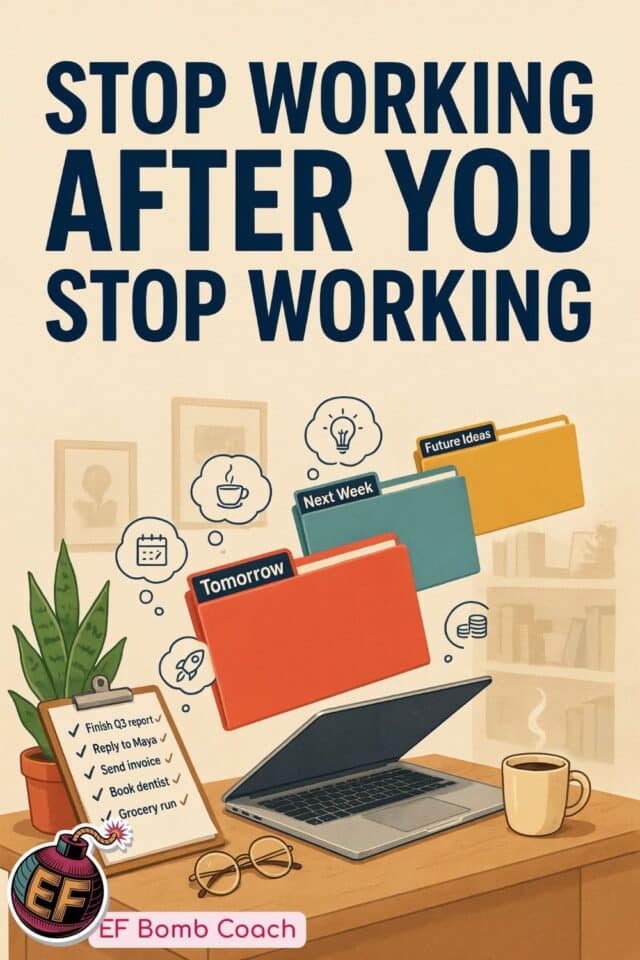
A 5-step shutdown routine that takes 10 to 15 minutes
You do not need a complicated system for this to work. You need a short routine you can repeat.
- Review the day quickly.
Keep this factual, not emotional. What got done? What didn't? What needs to be remembered? You're gathering data, not grading yourself. - Capture what's unfinished.
Anything still floating in your head needs to move into a trusted system. That could be a task manager, a notebook, your planner, or a voice memo. The goal is simple: get it out of your head and into a place you trust. - Write tomorrow's top three.
Not the ten things you'd love to finish. The three that matter most. If you choose them now, tomorrow starts with less friction and fewer decisions. - Reset your workspace.
Close tabs. Put papers in a pile instead of leaving them everywhere. Put away enough of today's mess that tomorrow doesn't begin in today's chaos. Do this digitally and physically. - End with one clear signal.
Pick one small action that tells your brain the day is done. Close the laptop. Put away your pens. Fold the sweater you wear at your desk. Say a phrase out loud. The action matters less than repeating it.
Closing the loop doesn't mean finishing the task
A lot of people miss this part.
An open loop is anything your brain is still tracking. A task you haven't done. A decision you haven't made. A commitment you made to someone. An idea you don't want to lose.
Your brain treats open loops like they are urgent because, in its mind, they might get dropped.
Closing a loop doesn't mean the task is done. It means the task has somewhere safe to live.
That task can be on tomorrow's list. It can have a date attached to it. It can be delegated. It can be written in your task manager with the next step noted. Once your brain trusts that it won't disappear, it can stop gripping it so hard.
That's what makes real rest possible.
You'll see this same idea show up in other ADHD-friendly work habits. The habit works because it reduces what your brain has to keep carrying after hours.

Did you know I have a membership for women who want to improve their executive function skills? Check it out here.
Your closing signal can be tiny, but it matters
This part sounds almost too simple, which is why people skip it.
A closing signal is one small, repeatable action at the end of the workday. It tells your brain, “We are done now.”
Cal Newport is known for saying “shutdown complete” out loud. That can sound a little silly the first time you hear it. But it works for a reason. It is clear. It is distinct. It happens at the same point every day.
That's what your brain needs.
You don't need his phrase. You need your version of the same thing.
Maybe it's closing a work-only app. Maybe it's changing out of work clothes and into soft clothes. Maybe it's making a cup of tea that you only make when work is over. Maybe it's a short walk around the block. Maybe it's putting your planner back in the drawer.
If you want the cue to work, pick something you'll do every day. Not the ideal thing. Not the aspirational thing. The real thing.
At first, you may not feel much from it. That's normal. If you've spent a long time ending work by collapse or interruption, your nervous system may not trust a new pattern yet.
Keep doing it anyway.
Repetition builds trust. Your brain learns by association. Over time, that tiny action becomes part of the handoff from work mode to home mode.
And once that association clicks, the signal starts doing more of the heavy lifting than you'd expect.
Hard days are when the routine matters most
The days you'll want to skip your shutdown routine are usually the days you need it most.
Messy day? Use it.
Frustrating day? Use it.
Demoralizing day where you didn't finish what you planned? Use it even more.
Those are the days when unfinished work carries more emotional weight. The open loops aren't only open, they feel charged. Your self-talk gets louder. The gap between what you hoped to do and what happened feels personal.
That's where you have to separate fact from story.
The fact might be, “You still need to write three emails.”
The story is, “You should have done five,” or “Why couldn't you get it together?”
The fact helps you plan. The story follows you into the evening and keeps you upset long after you've left your desk.
So when you review a hard day, stay with the facts. What happened? What didn't happen? What needs to move to tomorrow? What needs a date? What needs a next step?
Then do one more thing before you close out: name something that counted.
Not the biggest win. Not the most polished win. Something real that moved the needle. You answered a client. You fixed a problem. You finished one piece of a larger project. It counts.
Your brain doesn't need to end the day with a list of failures.
Make it small enough that you'll keep doing it
Knowing this would help and doing it every day are two different things.
So don't build a twenty-minute end-of-day routine with six apps, a color-coded planner, and a playlist. You'll do it for three days, then you'll stop because it takes too much setup.
Start with a two-minute shutdown.
That can be enough.
Here's a simple version:
- Review the facts of today for thirty seconds.
- Capture at least one open loop in your trusted system.
- Write tomorrow's top three.
- Do the same closing signal every day.
That's it. That counts.
Next, attach it to something that already happens. Dinner. School pickup. Feeding the dog. Locking the office door. Existing habits make good anchors because you don't have to remember from scratch.
A labeled alarm helps too. Not a random beep. A label that tells you what to do, like “Shutdown time” or “Close it out.” That small bit of language reduces the mental load.
Then remove friction. If your notebook is buried under paperwork, you won't use it. If your planner is in another room, you'll skip it. If your shutdown routine needs too many steps before it even starts, it's not ready yet.
Keep the tools visible. Keep the routine easy.
The payoff shows up the next morning. Your top three are already picked. Your workspace is less chaotic. You are not walking into the day dragging yesterday behind you. For a brain that struggles with task initiation, that matters a lot.
Try it for five days and notice what changes. Pay attention to how you sleep. Notice whether Monday morning feels different. See whether Tuesday starts with less fog and less resistance.
Give yourself a real ending
You do not need a perfect shutdown routine. You need one your brain can trust.
When you review the day, capture what is unfinished, choose tomorrow's top three, reset your space, and use one consistent closing signal, you stop carrying so much work into the rest of your life.
Rest gets easier when your brain believes the day is finished.