How to Stay Consistent Without Routines (For ADHD Brains That Hate Repetition)
The moment someone says “just build a routine,” do you feel your whole body tense up? You’re trying to run a business, you know consistency matters, and still, the idea of doing the same thing the same way every day feels like a trap.
Let's talk about how to stay consistent without forcing yourself into rigid routines. You’ll use flexible structure, energy-based choices, and built-in variety so you can keep publishing, serving clients, and moving your business forward without the “prison schedule” feeling.
Why routines feel like prison when your brain craves novelty
ADHD brains are hardwired to seek novelty. That’s not a personality flaw. It’s how motivation often shows up for you.
When something is new, your brain perks up. The first time you try a fresh idea, you can get a dopamine spike. It feels engaging, even easy. But by the 47th time, the same task can feel flat, irritating, or weirdly heavy, even if you still care about the outcome.
That’s why routines can feel less like support and more like a cage. It’s not just “I don’t like schedules.” It can feel like you’re being boxed in.
Here are the common reasons routine-heavy advice backfires:
- You feel controlled: “Do this at 9:00 a.m.” can trigger instant pushback.
- You feel limited: Routines can make you feel like there’s only one “right” way.
- You lose autonomy: When it becomes “I should,” motivation drops fast.
- You lose spontaneity: You start to feel like your real self is being edited out.
- You feel like you’re failing: Missing one day turns into “I can’t do anything consistently.”
That last one is the real trap. You see someone online praising their perfect morning routine, and you wonder why you can’t stick to something so “simple.” But what looks simple from the outside can feel unbearable from the inside when repetition drains your drive.
The good news is you don’t need routines to succeed. You need a different kind of structure.

Consistency vs. routines (they’re not the same thing)
A routine and consistency often get treated like twins. They aren’t.
A routine is doing the same thing, the same way, at the same time. Think: writing at 6:00 a.m. every day, no matter what.
Consistency is making regular progress. Period. You still write regularly, but you might write at 11:00 a.m. on Tuesday, record voice notes on Thursday, and outline on Sunday evening. The “what” happens. The “how” changes.
Both approaches can produce the same result. Both people finish the book.
The shift that matters is letting yourself separate the outcome from the process. You can keep your business moving without becoming a routine person.
You’re allowed to build consistency your way.
If you want extra perspective on why follow-through can be hard with ADHD and how people build support around it, you can compare notes with How You Can Maintain Consistency With ADHD.
Once you stop treating routines as the price of success, you can build something that feels flexible and still gets results.
Build frameworks that commit to outcomes, not a fixed process
Instead of routines, use frameworks.
A framework answers one question clearly: What must happen? Then it leaves the “how” open, so you have room to adapt day to day.
For example, you might decide: You publish three pieces of content per week.
That’s the framework. It’s a commitment to an outcome, not a demand for a specific routine. You’re not saying, “I publish every Monday at 9.” You’re saying, “Three pieces go out weekly.”
Define your non-negotiables first
Your non-negotiables are the results you’re committed to, even when your energy is low or your week is messy. In a business, common non-negotiables look like:
- Publishing content
- Client delivery
- Outreach and lead generation
- Admin and money tasks (invoices, follow-ups)
Pick the ones that truly matter right now, not the ones you think you “should” do because a productivity post said so.
Give yourself multiple pathways to hit the same outcome
Once you know the outcome, build variety into the method. You’re aiming for consistency in the what, and novelty in the how.
If your weekly outcome is “publish three pieces,” your pathways could include writing, recording a video, voice notes, email, or social posts. You choose based on capacity.
Here’s what that can look like in real life:
- Monday: you record a video because your energy is high.
- Wednesday: you publish an email because writing feels doable.
- Friday: you publish a short social post because you’re tired, but you can still show up.
Next week might be totally different. The outcome stays stable. Your execution stays flexible.
To make this concrete, you can set up a simple planning table like this:
| Outcome you want weekly | Minimum (must happen) | Maximum (high-capacity weeks) | A few ways to get it done |
|---|---|---|---|
| Publish content | 3 pieces | 5 pieces | email, short post, video, voice notes, carousel |
| Outreach | 2 touches | 5 touches | DM, referral ask, comment strategy, pitch email |
| Admin | 30 minutes | 2 hours | invoices, scheduling, inbox, bookkeeping |
This is the core idea: you commit to results, then give yourself freedom to choose your path each time.
Use anchor points instead of rigid schedules
If schedules make you rebel, try anchor points.
An anchor point is a trigger, not a clock time. It’s “after this thing, do that thing.” That gives you structure without locking you into one exact moment.
For example:
After coffee, create something.
That could happen at 7:00 a.m. or 10:00 a.m. It still counts. You’re using a reliable part of your day as a cue, not forcing yourself to obey a timestamp.
Anchor points can also be tied to transitions:
- After you finish a client call, do one admin task.
- After lunch, do one outreach touch.
- At the end of your workday, pick tomorrow’s top three priorities (even if “end of day” moves around).
You get regular touch points without feeling trapped. And when a day goes sideways, you adjust without declaring the whole system broken.
This is structure that bends instead of snapping.
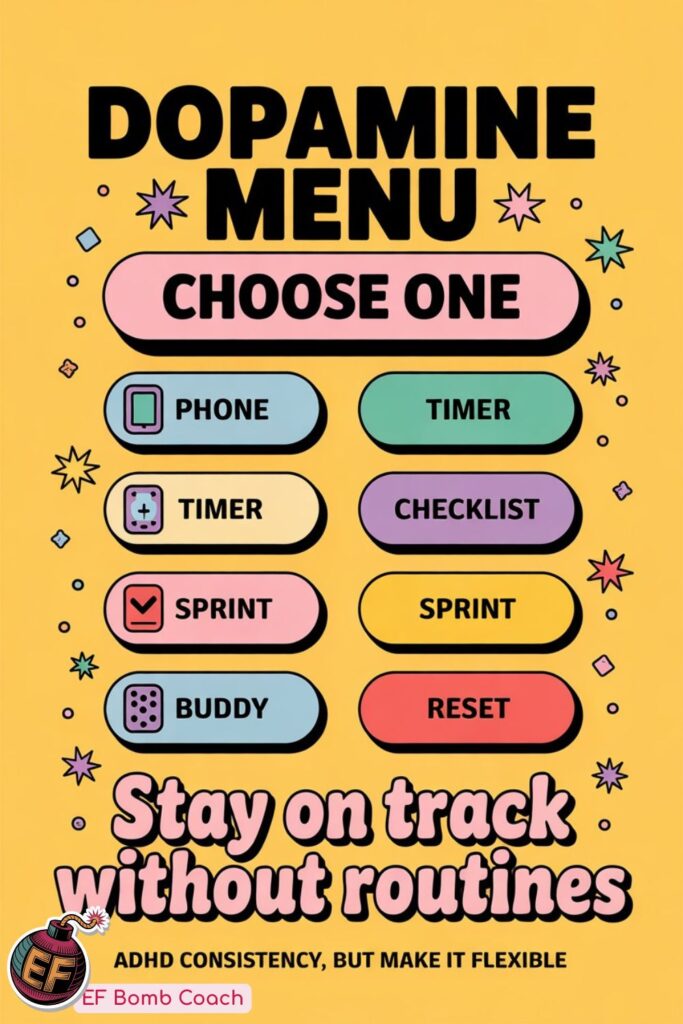
Create a rotating menu so you don’t get bored
A powerful anti-routine move is building a menu of ways to achieve the same goal.
Instead of “I post on Instagram every Monday,” you switch to:
I show up for my audience three times per week.
Now you create 7 to 10 options for what “show up” can mean. Then each day, you choose the option that matches your energy and interest.
A practical menu might include:
- Post a short video
- Publish a written post
- Share a quick tip in stories
- Reply to comments and DMs
- Engage inside your group
- Send an email to your list
- Republish an older post with a new intro
This is where your brain gets what it wants. You still hit the same weekly outcome, but it never has to feel like copy-paste misery. Low energy day? Choose engagement or a simple post. High energy day? Record the video.
Use theme days and plan by energy (not by time)
Theme days give you structure without forcing repetition.
You’re not assigning exact tasks to a day. You’re assigning a category. Your brain knows what kind of work you’re doing, but you still get variety inside the theme.
Theme-based organization that stays flexible
Here’s how theme days can look:
- Monday: content creation (this week video scripts, next week email drafts)
- Friday: admin day (one week invoices, another week scheduling and inbox)
- Mornings: strategic work (planning one day, designing another day)
The point is you reduce decision fatigue without demanding sameness. And if life happens, you swap themes without drama.
Schedule by energy, not by the clock
Time-based planning assumes you’ll have the same energy at 10:00 a.m. every Tuesday. That’s rarely true.
Instead, sort your tasks by the energy they require. Then pick from the right list based on how you feel that day.
| Energy level | What fits well |
|---|---|
| High energy | creative work, launching tasks, complex problem solving, recording video |
| Medium energy | admin, editing content, planning, routine communication |
| Low energy | filing, organizing, scheduling pre-created content, simple email replies |
This removes the shame spiral. On a low-energy day, you’re not “failing” by skipping high-energy tasks. You’re matching the day you have to the work that fits.
Micro-batching without the punishment feeling
Batching can be efficient, but traditional batching can feel like torture if it locks you into hours of the same task.
So change the rule: batch by energy type, not by identical tasks.
Try a 90-minute “creation batch” where you rotate through different creative outputs:
You might outline three videos, record two, draft one email, then sketch three social graphics. It’s all creation work, but it stays interesting because the format changes.
Also, keep the cap. If you try to force four straight hours of one task, you’re more likely to burn out and avoid it next time.

Set ranges so real life doesn’t break your consistency
Rigid targets are fragile. They work until they don’t, and then you feel like you blew it. Ranges are sturdier.
Instead of “post every day at 9:00 a.m.,” you set something like: Publish three to five posts per week.
Now you have:
- A minimum you commit to no matter what
- A maximum you aim for when capacity is high
- A wide middle where you’re still succeeding
If your minimum is three and your maximum is five, publishing four is success. Publishing three on a hard week is still success. You stop treating consistency like perfection.
This is also a smart way to handle “shiny new object syndrome.” You don’t have to crush your curiosity. You can schedule it.
Try building novelty into your system on purpose:
- Monthly: test a new content type, format, or topic angle
- Quarterly: adjust your focus or experiment with a new platform
You can also create novelty without changing the work at all. Change the environment: write at a coffee shop, then at your desk, then outside. Swap your music. Use a notebook one day and your computer the next. Your brain reads “different setting” as “new,” even when the task stays the same.

Did you know I have a membership for women who want to improve their executive function skills? Check it out here.
Accountability that supports outcomes (not strict routines)
Accountability can help, but only if it matches what you’re trying to build.
Process-based accountability sounds like: “Did you write at 6:00 a.m.?” That kind of pressure can kill motivation fast.
Outcome-based accountability sounds like: “Did you publish this week?”
A few flexible options that keep the focus on results:
- Co-working sessions (body doubling), where everyone works on different tasks
- Public commitments that name your goal but leave the method open
- Weekly check-ins with a business buddy who respects that your execution can change
Bad accountability enforces routines. Good accountability supports consistency.
Stop trying to become a routine person, start with one outcome
You don’t need to become someone who loves routines to run a successful business. Flexibility doesn’t make you flaky. It makes you adaptable, and it can keep your business fresh.
If you want a simple way to start without overhauling everything, keep it small:
- Pick one outcome you want weekly (content, outreach, client delivery, admin).
- List five to seven ways you can achieve it.
- Rotate methods based on your energy that day.
- Notice what works best in high, medium, and low capacity weeks.
Every time you choose a different method and still publish the outcome, that’s proof your system is working.
If routines make you miserable, you don’t have to force them. You can build consistency by committing to outcomes and staying flexible in the process, using frameworks, anchor points, menus, energy-based planning, and ranges that hold up in real life.
Pick one outcome to focus on this week, write down a few ways you can hit it, then choose the method that fits the day you’re having. After that, you can adjust and keep going, consistently and differently.