The ADHD Decision-Making Framework That Clears Your “Maybe” Pile
How many open loops are sitting in your head right now? The email you have not answered, the client inquiry you keep rereading, the collaboration idea that sounded fun at first, the “I’ll decide later” offer that keeps popping up when you try to focus.
That pile of maybe decisions can feel harmless, like you're buying yourself time. In practice, it quietly drains you. Your brain keeps each maybe in working memory, circling back to it, layering guilt on top of it, and burning energy you needed for real work and real life.
This post gives you a simple ADHD-friendly decision-making framework with one goal: get decisions out of limbo fast, without relying on a gut reaction that changes with dopamine, mood, or fatigue.
Why “maybe” decisions drain you more than you think
A maybe is not a neutral parking lot. It is like keeping 27 browser tabs open, all playing sound at a low volume. You can pretend it is fine, but your attention keeps getting pulled.
When you have ADHD, that pull costs more. Your executive function is already doing extra behind-the-scenes work all day. So every unresolved decision takes up space that could have gone to planning, starting, finishing, or even resting.
Here are a few common “maybe” traps that often show up in business and day-to-day life:
- The message you haven't answered because you are not sure what you want to say
- A podcast invite or speaking request you feel excited about, but also dread
- A new service idea you keep “saving for later,” even though your current offer needs attention
- A client inquiry you are avoiding because you do not know if you can fit it in
- A software tool trial you started, then forgot, then remembered, then felt guilty about
Each one seems small. Together, they create a constant low-level drain: background stress, background guilt, background “I should handle that.”
This is why you can sit down to do focused work and feel tired before you start. It's not laziness. It's mental load.
The fix is not “try harder.” The fix is having a decision system that removes maybes on purpose.
Why “hell yes or no” breaks down with ADHD
You've probably heard the rule: “If it’s not a hell yes, it’s a no.” It is clean. It is simple. It sounds like the kind of bold clarity you want.
The problem is that ADHD can make your “hell yes” meter unreliable.
Some days, a new opportunity hits you with novelty and dopamine, and it feels like an instant yes. Then tomorrow comes, the details land, and it suddenly feels heavy. Now you're stuck trying to backpedal, or you push through and resent it.
Other days, you're in decision fatigue. Everything feels like a no. Even good opportunities feel like too much because your capacity is tapped.
And then there is rejection sensitivity. Saying no can feel risky, even if you know it's the right call. Your brain runs worst-case scripts: they'll be mad, they'll think you're flaky, you just lost the only chance, you ruined the relationship.
So the binary rule can backfire. It can make you overcommit during a dopamine high, then disappear during overwhelm. Or it can make you shut down and say no to things you actually wanted, just because you were depleted in the moment.
If you want context for why decision fatigue hits so hard with ADHD, this overview from Psychology Today can help: decision fatigue and ADHD explained.
You don't need a louder gut. You need a better process.
The ADHD version: three categories, not two
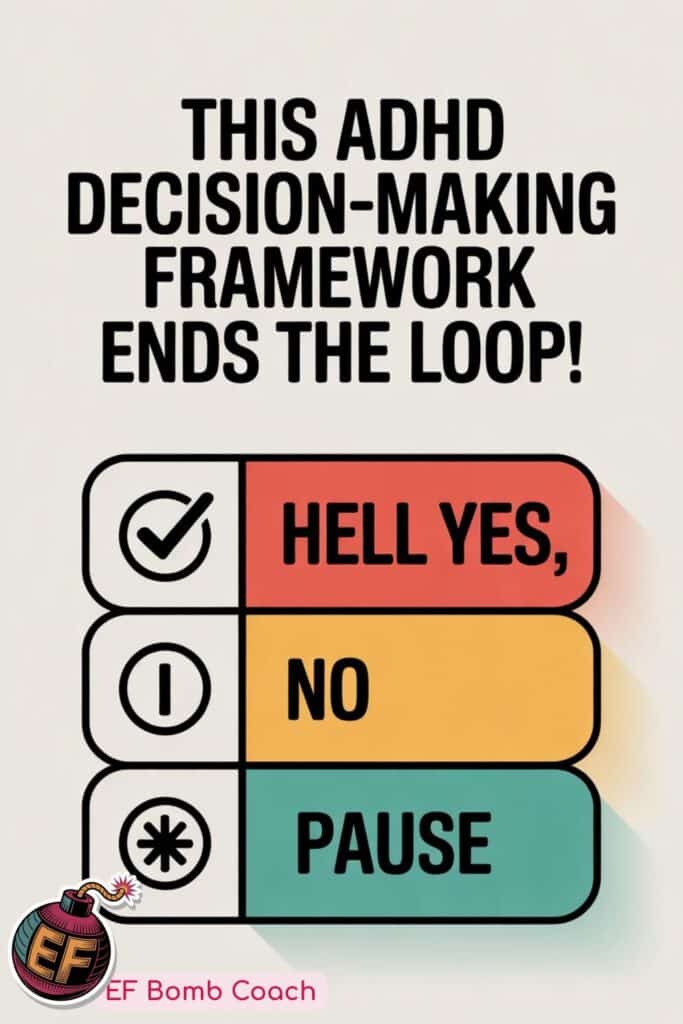
Instead of forcing every choice into yes or no on the spot, you use three clear categories:
| Category | What it means | What it feels like |
|---|---|---|
| Hell yes | Clear alignment and a true fit | Energizing, obvious, you can see the follow-through |
| Hell no | Clear misalignment | Draining, off-path, you feel tension or dread |
| Pause | Unclear, needs quick evaluation | Not a maybe forever, a short decision window |
The key difference is Pause.
Pause is not a “someday” list. It is a temporary holding space with a deadline and a method. You're not ignoring the decision, you are scheduling the decision.
This matters because uncertainty is what drains you most. When you move decisions out of limbo, you free up attention fast. And you do it without relying on whichever emotional weather your brain is experiencing that day.

Use quick gut checks to sort decisions fast (without overthinking)
You're still allowed to have instincts. You just don't let a single feeling make the whole call. The goal is to run a fast screen, then either decide or move it into Pause.
The “hell yes” screen
When something comes in, ask yourself a few quick questions. Keep it simple and honest.
- Does this align with where you're taking your business right now, or is it a shiny object?
- Do you actually have capacity for it, or are you already drowning?
- Would you be excited to tell someone about it, or would you feel embarrassed explaining why you said yes?
- Can you realistically see yourself following through, or are you only excited about the idea?
If you can answer yes to four or more, it is probably a true hell yes. If you are at three or fewer, you don't commit yet. You move it to Pause and evaluate it with a system.
The “hell no” markers that save you from guilt
A hell no is not only “bad opportunities.” It's also “wrong for you right now.”
If three or more of these feel true, treat it as a hell no:
- It pulls you away from what you're trying to build.
- You're considering it because you think you should.
- It's mainly about meeting someone else’s expectations.
- Saying yes means sacrificing something that matters (family time, your signature offer, your mental health).
- You're saying yes because of FOMO or guilt.
This is where you stop arguing with yourself. You can respect an opportunity and still decline it.
Make “Pause” work: set a deadline, then score it
Pause only helps if it has structure. Otherwise it becomes a prettier version of maybe.
Set a real deadline (and put it on your calendar)
Not “this week.” Not “when I have time.”
Pick something concrete like Tuesday at 3 p.m., or within 48 hours. Then put it in your calendar as an appointment with yourself, for example: “Decide on podcast interview request.”
During the pause window, you gather the missing pieces:
- Check your calendar for actual time, not imagined time.
- Ask one clarifying question if you need it.
- Run the numbers if money is involved.
- Look at what you would have to postpone to make this happen.
Then, at the deadline, you choose: hell yes or hell no. No extensions. No moving it to a bigger maybe list.
Score the opportunity on five criteria
This is the part that makes the decision feel fair, even when your emotions are loud.
Score each item from 1 to 5 (1 is low, 5 is high):
| Criteria | 1 | 3 | 5 |
|---|---|---|---|
| Alignment | Off-track | Somewhat aligned | Directly supports this year’s goals |
| Capacity | No room | Tight but possible | Plenty of room |
| Energy | Draining | Neutral | Energizing |
| ROI (realistic) | Low return | Some return | Strong return (money, exposure, skills, joy) |
| Opportunity cost | High cost | Moderate cost | Low cost |
Add your score out of 25.
- 20+: Hell yes.
- Under 15: Hell no.
- 15 to 20: A genuine close call. Choose either way, but choose by the deadline.
If you get stuck in that middle zone, you can even flip a coin. The point is not to find the perfect choice. The point is to stop bleeding energy through indecision.

Did you know I have a membership for women who want to improve their executive function skills? Check it out here.
Handle rejection sensitivity so “no” doesn't feel dangerous
When you have rejection sensitivity, a simple no can feel like you're setting off an alarm. Your brain predicts fallout and treats it like an emergency.
In reality, protecting your capacity is professional. It's often more professional than saying yes, then disappearing, missing deadlines, or delivering a half-done result because you're overwhelmed.
A useful script keeps it kind and clear:
“This isn’t the right fit for me right now, but I’d love to stay connected for future opportunities.”
That one sentence does two things at once. It closes the loop, and it keeps the relationship intact.
It also helps to remember: a no right now is not a no forever. Good opportunities come back around, especially when you are consistent and clear.
If you want more detail on what rejection sensitivity can look like with ADHD, this breakdown is a helpful reference: coping strategies for rejection sensitivity and ADHD.
Spot dopamine-driven “yes” decisions before they cost you
Sometimes everything feels like a hell yes, not because it is right, but because it's new. ADHD brains tend to prioritize what's interesting over what's important, especially when the current work feels repetitive.
When you feel that rush of excitement, use a quick reality check:
- If you had to start this today, would you still be excited?
- What will you not do if you say yes to this, and are you okay with that trade?
- Is this interesting because it's new, or because it supports what you're building?
- Will you still care about this in three months?
Those questions don't kill your creativity. They protect it. You're making sure your excitement is pointing at something you can actually carry.
What to do when nothing feels like a “hell yes”
There's another pattern that can confuse your decisions: the season when everything feels hard.
That's often decision fatigue. You're depleted, so your brain labels every new commitment as a threat. In that state, your decision-making isn't broken, it's offline.
Here is a simple protocol that keeps you from making choices you will regret:
- Name it: “I’m in decision fatigue.”
- Default to no for anything that isn't urgent.
- Give yourself 24 hours before saying yes to anything.
- Focus on recovering capacity first, then revisit.
A temporary no that you can revisit is safer than a yes you resent.

The ADHD capacity tax is real, so treat capacity like your top asset
You probably think you have more room than you do.
When executive function is harder, baseline tasks cost more energy. Planning, starting, switching tasks, and remembering details can eat up a big chunk of your day before you even touch the real work. This is part of what people mean when they talk about the ADHD tax. For more on that concept, see the unseen cost of the ADHD tax.
There is also a second layer that gets missed: every yes isn't just one yes.
When you say yes to an opportunity, you're also saying yes to:
- The follow-up emails
- The scheduling
- The prep work
- The extra decisions
- The task switching
- The execution
- The clean-up afterward
Overcommitting doesn't just make you busy. It can make you freeze. When the pile gets too high, you shut down and nothing moves.
So capacity isn't a nice-to-have. It's the foundation that makes everything else possible.
Say no to good things so you have space for great things. Turn down interesting projects so you can fully commit to the important ones. Your future self will feel the difference.
A permission slip you can actually use
You're allowed to say no. Not just to bad offers, but to good ones that do not fit.
You're allowed to say no to things that would be perfect for other people.
You're allowed to change your mind after you gather info during Pause.
You're allowed to protect your capacity more than you protect someone else’s expectations.
You're allowed to disappoint people briefly and still be kind and professional.
This is your business, your life, your brain, your time. You are the one who lives with the results.
Keep building your decision muscle with support
When your inbox is full of open loops, the goal is not to become a different person. The goal is to make fewer maybes, choose faster, and protect capacity like it matters.
The real win is not the perfect decision. It is fewer decisions stuck in limbo, and more energy left for the work you actually care about.