Neurological Overwhelm When Your Prefrontal Cortex Goes Offline
You know what needs to happen. You might even have the plan, the deadline, and the motivation. But you're still staring at your screen, opening tabs, closing tabs, and getting exactly nowhere.
That isn't laziness. It isn't proof that you don't care enough about your business. Neurological overwhelm is what happens when your brain runs out of room to hold, sort, and act on everything coming at you.
Before you try to force your way through it, it helps to understand what your brain is doing and what it needs instead.
Overwhelm Is Not a “Try Harder” Problem

You have probably heard some version of this your whole life: “If you tried harder, you'd get it done.”
Maybe a teacher said it. Maybe a family member said it. Maybe it is the nasty little voice in the back of your own head that says it every time you fall behind.
Here's the problem. Trying harder is not a useful plan when your brain has already hit capacity.
Overwhelm is not a mood you can fix by drinking water and making a prettier to-do list. It is not a character flaw, either. It is your brain reaching a system limit.
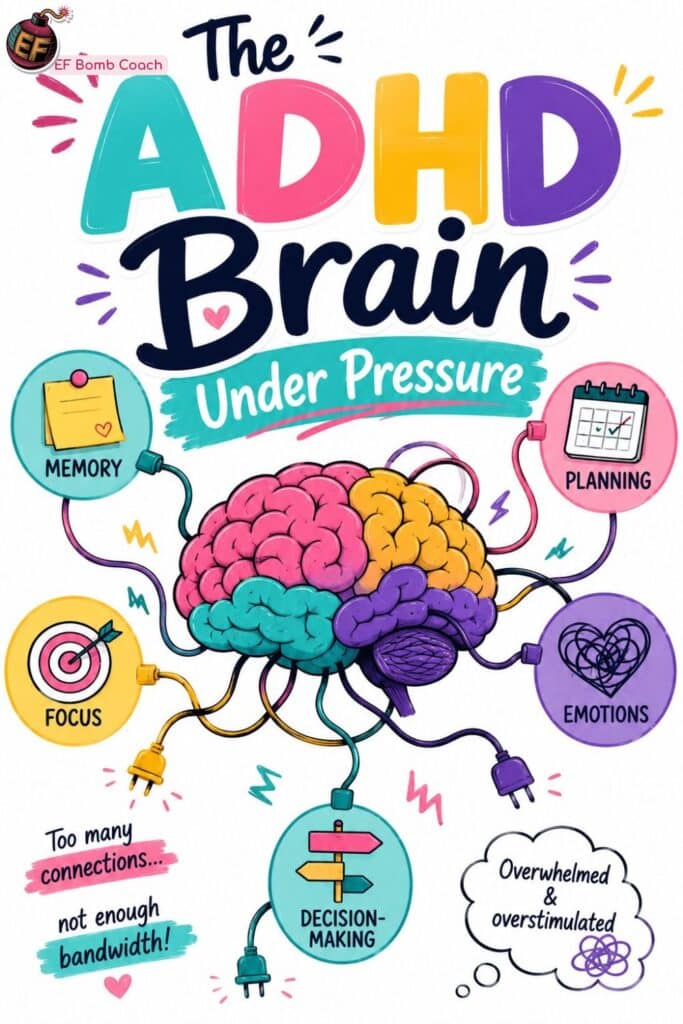
Think about your working memory like the RAM on a laptop. It can only hold so much at once. When it is full, it does not matter how much you want one more program to run. There is nowhere for it to go.
Then your executive function starts to struggle. Planning, prioritizing, starting, remembering what you were doing, choosing between options, and regulating your emotions all require mental energy. Executive function skills are the skills that help you organize, focus, manage time, and follow through. When your brain is overloaded, those are often the first things to get shaky.
Your nervous system can also read a packed inbox, an overdue proposal, and three client messages as a threat. No, your brain does not think an email is a tiger. But it can react to too many demands like there is danger coming from every direction.
That is when everything starts to feel equally urgent, equally impossible, and way too big. You cannot choose a starting point, so you freeze.
When your brain is at capacity, more pressure does not create more capacity. It usually makes the shutdown happen faster.
Why ADHD Brains Can Hit Capacity Faster
If you're neurodivergent, especially if you have ADHD, you may already be using extra energy before you even begin the task in front of you.
You might be trying to remember what was said three conversations ago because working memory is unreliable. You might be filtering sounds, lights, movement, and people around you. You might be monitoring your own tone, worrying about rejection, or trying not to forget the thing you meant to do five minutes ago.
That is a lot of background activity.
Picture one laptop running a single browser window. Now picture another laptop running 53 tabs, three software updates, and a full antivirus scan at the same time. Then somebody tries to open a giant spreadsheet.
That second laptop is not broken. It is busy.
Research has found executive-function difficulties in people with ADHD, including challenges that affect attention, working memory, and self-regulation. You can see a research overview of executive-function deficits in ADHD if you want the science side of why tasks can take more effort than they appear to from the outside.
This is why willpower cannot be your whole business strategy. Willpower runs on the same mental fuel you have already spent trying to start, focus, switch tasks, remember details, and manage your stress response.
You do not have a motivation deficit when you are sitting there desperate to do the thing but cannot make yourself begin. You have a resource deficit.
The Three Types of Overwhelm
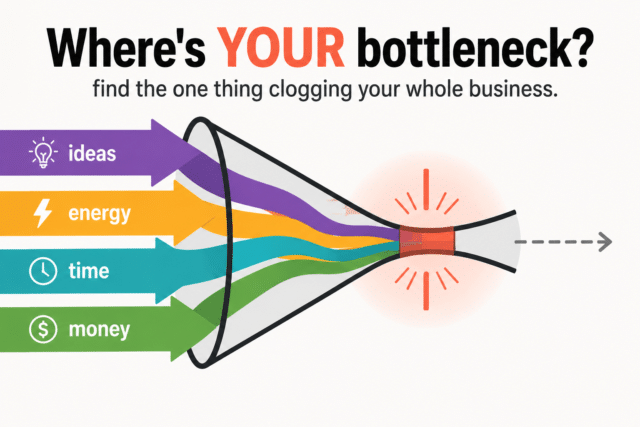
Not every overwhelmed day is the same. If you keep trying to solve emotional overwhelm with a new planner, or decision overwhelm with more information, you are going to stay stuck.
Naming what kind of overwhelm you are in gives you a better place to start.
| Type of overwhelm | What it can feel like | What helps first |
|---|---|---|
| Information overwhelm | Too many emails, messages, ideas, tabs, and conversations | Reduce input and create processing space |
| Decision overwhelm | Too many choices or fear of making the wrong call | Narrow options and use defaults |
| Emotional overwhelm | Anxiety, rejection sensitivity, shame, grief, or dread | Regulate your nervous system before tackling tasks |
The goal is not to diagnose yourself perfectly in the middle of a hard day. The goal is to stop treating every type of overwhelm like a discipline problem.
Information overwhelm means your brain has too much to sort
Information overwhelm happens when the input is coming in faster than your brain can process it.
Maybe you have 14 tabs open and cannot remember why any of them are there. Your inbox has become a weird little haunted house. Every new message seems important, and you have content ideas, client notes, half-finished documents, and a running list in your head that will not shut up.
The answer is not to organize every bit of it immediately. That can become another giant task.
You need less input for a minute. Stop opening new tabs. Pause notifications if you can. Put new ideas in one parking-lot note instead of trying to act on each one the second it appears.
Then give your brain room to process what is already there.
Decision overwhelm shows up when every option feels risky
Decision overwhelm is common when you are getting ready to launch, setting prices, choosing a platform, deciding what to delegate, or thinking about hiring someone.
There may not be one obvious correct answer. So your brain keeps trying to calculate every possible outcome, every risk, every way you could regret it later.
That is exhausting.
You need fewer choices, not more research. Give yourself a small number of options. Use templates for repeat decisions. Create defaults for the things you do often. For example, you might decide that all discovery calls happen on two afternoons each week, rather than re-deciding your availability every single time someone asks.
A decision does not have to be perfect to move your business forward. It needs to be good enough for the information you have right now.
Emotional overwhelm starts in your body, not your task list
Emotional overwhelm is what happens when anxiety, rejection sensitivity, shame, grief, fear, or stress piles on top of your actual workload.
You may have ten tasks on your list, but your nervous system is already carrying the weight of a difficult client email, a launch that did not go how you hoped, or the feeling that everybody else is doing business better than you.
At that point, your to-do list is not the first problem.
You cannot think your way out of a nervous-system response. Start with your body. Take two minutes to walk around the room, stretch, shake out your arms, drink water, eat a snack, step outside, or change locations.
Those things are not silly little distractions. They tell your brain that you are safe enough to come out of survival mode.
Why Shame Makes Overwhelm Worse
Overwhelm often gets followed by shame at lightning speed.
You cannot start the task. Then you think, “Why can't I just do this?” You replan your week for the fourth time. You see the unfinished project. You decide you must be lazy, irresponsible, incapable, or bad at business.
Nope.
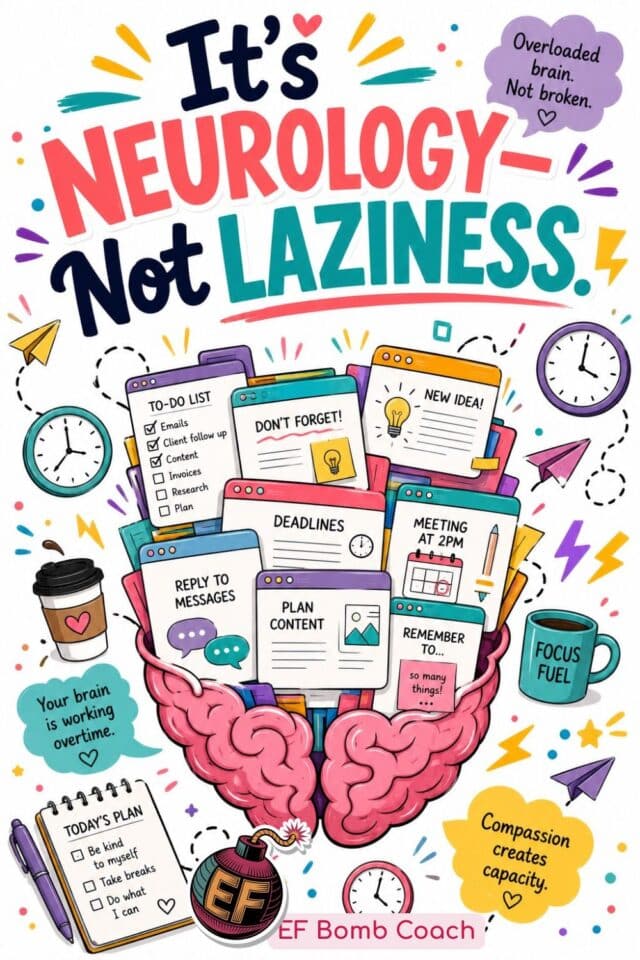
Shame adds stress to a brain that is already overloaded. Your ability to plan, prioritize, and initiate tasks does not improve when you are calling yourself names. It gets harder.
Trying to muscle through overwhelm is like trying to make an emergency call on a dead phone. You can need the call to go through with every cell in your body. The phone still has no battery.
That does not mean you should give up. It means the answer is not more self-punishment.
You cannot shame yourself into having more capacity.
Overwhelm has a real business cost
This is not only about feeling bad, although feeling like crap all the time is reason enough to care.
Overwhelm costs money and opportunities in your business. The lead you meant to follow up with is sitting in your inbox. The launch is 80% done, but perfectionism and shutdown keep you from crossing the finish line. You spend hours re-planning your week because planning feels productive, but the actual work never gets touched.
Clients can feel the impact, too. You might under-serve someone because you are running on empty. You might say yes too quickly because making a decision feels hard, then realize you do not have the capacity to deliver without burning yourself out.
Building systems that account for your real brain is not a luxury. It is a business decision.
That can include setting boundaries around your time, creating repeatable client workflows, and saying no when a new commitment would blow up your already-full week. If saying no is hard, this time-management approach for entrepreneurs has useful ideas for protecting your attention and choosing what belongs on your plate.

Use Overwhelm Triage When Your Brain Is Full
You are probably in overwhelm if any of this sounds familiar:
- You have a pile of browser tabs open and no clue why half of them are still there.
- Your to-do list makes you want to close your laptop and lie on the floor.
- You keep re-planning your week instead of working the plan.
- You know exactly what needs to be done, but you cannot start any of it.
- You are busy all day, but nothing gets finished.
- Checking email creates that awful tight feeling in your chest.
If you see yourself in two or more of those, do not add another app, system, color-coded planner, or productivity podcast to the pile.
When you are in overwhelm, the answer is less, not more.
Four steps to get functional again
This is not a productivity framework for your ideal Tuesday. This is triage for the moment when your brain is full and you still need to function.
- Freeze the inputs. Do not add another commitment. Stop opening tabs. Do not say yes to one more thing because it will only take five minutes. Give the pile a chance to stop growing.
- Empty the bucket. Get everything out of your head. Use paper, a document, a notes app, or a voice memo. Do not organize it. Do not prioritize it. Do not turn it into a beautiful project plan. Dump it out.
- Pick one needle-moving task. Not your top five priorities. Not three important things. One thing. Make it painfully clear, too. “Work on my business” is not a task. “Write the first three bullet points for my sales page” is a task.
- Lower the bar for done. Send the ugly draft. Reply with three sentences. Spend 10 minutes on the first step. A finished imperfect task beats a perfect task that lives in your head forever.
If 25-minute focus sessions work for you, great. If 25 minutes feels like a damn marathon today, use 10 or 15. A short sprint with a real break can get you moving without pretending your capacity is unlimited.
After a sprint, take an actual break. Stand up. Stretch. Walk to another room. Look outside. Do not call checking email or scrolling social media a break, because your brain is still processing input.
A five-minute reset can change the next work block. You do not have to earn rest by finishing everything.

Did you know I have a membership for women who want to improve their executive function skills? Check it out here.
Build Scaffolding Instead of Relying on Discipline
Once you are out of immediate overwhelm, you can build systems that catch things before they all land in your brain at once.
This is scaffolding. It is the external support that makes running your business less dependent on remembering everything, deciding everything, and pushing through everything by force.
Your scaffolding might include a template for client replies, a recurring calendar block for invoicing, a standard checklist before every launch, or a simple weekly CEO check-in. It might mean a body-double session where you work alongside someone else, even if you are each working on different things.
You can also make your planning more honest.
Your brain has to account for task initiation, transitions, interruptions, recovery time, and the fact that some days your executive function is running on backup power. A task that takes 30 minutes on paper might need 15 minutes to start, extra time to switch into it, and a break afterward.
That does not mean you are bad at time management. It means your plan needs to include real life.
Build a minimum viable day, too. On a messy day, what are the one to three things that make the day count? Maybe it is following up with two leads, sending one client deliverable, and paying one invoice.
That is enough. Your business does not need you to be a productivity robot. It needs systems you can restart after a rough week.
Name the Overwhelm Before It Runs the Show
The next time you hit the wall, pause long enough to name what is happening.
Is it information overwhelm? Decision overwhelm? Emotional overwhelm? Maybe it is all three, because sometimes life likes to pile it on.
Naming it will not magically clear your inbox or finish your launch. But it interrupts the spiral. It gives the thinking part of your brain one small, manageable job instead of asking it to solve your whole life at once.
You are not failing because you cannot force more work from a brain that has already run out of fuel. Overwhelm is a capacity signal. Listen to it, lower the load, and give yourself one clear next step.